Cotton candy: Difference between revisions
CSV import |
CSV import |
||
| Line 29: | Line 29: | ||
[[Category:1904 introductions]] | [[Category:1904 introductions]] | ||
{{food-stub}} | {{food-stub}} | ||
<gallery> | |||
File:Cotton_candy_Μαλλί_της_γριάς.JPG|Cotton candy on a stick | |||
File:MapleCandyFloss.jpg|Maple flavored cotton candy | |||
File:Cotton_Candy_Machine.jpg|Cotton candy machine | |||
File:Watagashi_2013_(9527560798).jpg|Japanese cotton candy (Watagashi) | |||
File:A_man_selling_cotton_candy.jpg|A man selling cotton candy | |||
File:Man_makes_cotton_candy_in_cotton_candy_machine.jpg|Man making cotton candy in a machine | |||
</gallery> | |||
Latest revision as of 11:08, 18 February 2025
Cotton candy (also known as fairy floss in Australia and candy floss in the UK, Ireland, New Zealand, and South Africa) is a form of spun sugar. The confection is made by heating and liquefying sugar and spinning it out through tiny holes where it solidifies in midair and is collected on a larger spinning cone.
History[edit]
The concept of spun sugar has been around since the 15th century. However, the invention of machine-spun cotton candy is credited to William Morrison and John C. Wharton, candy-makers from Nashville, Tennessee, USA, who introduced their "Fairy Floss" at the 1904 World's Fair in St. Louis, Missouri.
Production[edit]
Cotton candy is made by heating and liquefying sugar, then spinning it out through tiny holes where it solidifies in midair and is collected on a larger spinning cone. The process requires specialized equipment, typically a cotton candy machine, to produce the candy's distinctive light, fluffy texture.
Consumption[edit]
Cotton candy is often consumed at carnivals, circuses, and fairs. It is sold in plastic bags or on a stick or cone and is eaten by hand. Despite its airy texture, cotton candy is essentially pure sugar and should be consumed in moderation.
Varieties[edit]
While traditional cotton candy is pink or blue and has a simple sugar flavor, many different flavors and colors of cotton candy can be found today. Some popular flavors include bubblegum, watermelon, and grape.
Health concerns[edit]
As cotton candy is essentially pure sugar, it is high in calories and offers no nutritional value. Regular consumption can contribute to obesity and tooth decay.
In popular culture[edit]
Cotton candy has been featured in numerous films, television shows, and songs, often as a symbol of childhood innocence or the ephemeral nature of pleasure.
See also[edit]

-
 Cotton candy on a stick
 -
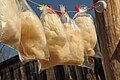 Maple flavored cotton candy
 -
Cotton candy machine
-
Japanese cotton candy (Watagashi)
-
A man selling cotton candy
-
Man making cotton candy in a machine


.jpg)

