Sujuk: Difference between revisions
CSV import |
CSV import |
||
| Line 26: | Line 26: | ||
{{food-stub}} | {{food-stub}} | ||
<gallery> | |||
File:Sucuk-1.jpg|Sujuk | |||
File:Sudzhuk_from_Armenia_2.JPG|Sudzhuk from Armenia | |||
File:Sudjuk.jpg|Sudjuk | |||
File:Sucuk-1.jpg|Sujuk | |||
File:Sucuk_(1).jpg|Sujuk | |||
File:Sucuk_with_eggs.jpg|Sujuk with eggs | |||
File:Samuna_me_suxhuk.JPG|Samuna me suxhuk | |||
</gallery> | |||
Latest revision as of 11:08, 18 February 2025
Sujuk is a dry, spicy sausage consumed in various countries across the Middle East, Central Asia, and the Balkans. The sausage is made from ground meat, usually beef, but also lamb, mixed with various spices, including cumin, sumac, garlic, salt, and red pepper, before being packed into a sausage casing and left to dry for several weeks.
History[edit]
The origins of Sujuk are believed to date back to the Ottoman Empire, where it was a popular food among the military and the wider population due to its long shelf life and high protein content. The sausage has since spread to various countries across the Middle East, Central Asia, and the Balkans, where it is consumed as part of a traditional breakfast, in sandwiches, or used as an ingredient in other dishes.
Preparation and Consumption[edit]
The preparation of Sujuk involves grinding the meat and mixing it with the spices, before stuffing the mixture into a sausage casing. The sausage is then left to dry for several weeks, during which time it develops its characteristic spicy flavor.
In terms of consumption, Sujuk can be eaten raw, but it is more commonly cooked before eating. It can be fried in a pan, grilled, or added to dishes such as stews and casseroles. In some countries, it is also a popular addition to breakfast dishes, often served alongside eggs and bread.
Variations[edit]
There are many variations of Sujuk across different countries. In Turkey, for example, the sausage is often made with beef and a high amount of garlic. In Armenia, it is commonly made with beef and pork, and has a strong flavor of cumin. In Bulgaria, the sausage is typically made with pork and is less spicy than its counterparts in other countries.
Health Considerations[edit]
While Sujuk is high in protein and can be a good source of iron, it is also high in fat and sodium, which can contribute to various health problems if consumed in excess. As such, it is recommended to consume Sujuk in moderation as part of a balanced diet.

-
 Sujuk
Sujuk -
 Sudzhuk from Armenia
 -
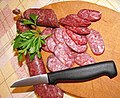 Sudjuk
 -
Sujuk
-
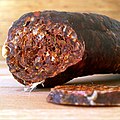 Sujuk
Sujuk -
 Sujuk with eggs
 -
 Samuna me suxhuk


.jpg)


