Tiki bar: Difference between revisions
CSV import |
CSV import |
||
| Line 28: | Line 28: | ||
[[Category:Polynesian culture]] | [[Category:Polynesian culture]] | ||
{{food-stub}} | {{food-stub}} | ||
<gallery> | |||
File:Seattle_-_Kalua_Restaurant,_1953_(33739104762).jpg|Kalua Restaurant, Seattle, 1953 | |||
File:Aloha-_Clifton's_Pacific_Seas,_618_So._Olive_St.,_Los_Angeles_(90819).jpg|Clifton's Pacific Seas, Los Angeles | |||
File:BaliHaiNOLA59Postcard.jpg|Bali Hai, New Orleans, 1959 | |||
File:Trader_Vic's_1944_Mai_Tai.jpg|Trader Vic's 1944 Mai Tai | |||
File:Tiki4.jpg|Tiki Bar | |||
File:Butlins_Ayr_in_1985_-_Beachcomber_Bar_entrance.jpg|Beachcomber Bar entrance, Butlins Ayr, 1985 | |||
</gallery> | |||
Latest revision as of 11:06, 18 February 2025
Tiki bar
A Tiki bar is a type of bar that is designed in the style of the Polynesian tropical islands. The concept of Tiki bars originated in the United States in the mid-20th century, although it has since spread to other parts of the world. The term "Tiki" is derived from the Maori word for a type of carved human figure, and Tiki bars often feature such carvings as part of their decor.
History[edit]
The first Tiki bar, named "Don the Beachcomber", was opened in Los Angeles, California in 1933 by Ernest Raymond Beaumont Gantt, who later changed his name to Donn Beach. This was followed by the opening of "Trader Vic's", another influential Tiki bar, in Oakland, California in 1937 by Victor Jules Bergeron Jr.. These bars were characterized by their exotic-themed decor, which included items such as bamboo furniture, tropical plants, and Tiki carvings.
Characteristics[edit]
Tiki bars are known for their distinctive decor, which is designed to evoke the atmosphere of a tropical island paradise. This often includes elements such as bamboo furniture, thatched roofs, and Tiki torches. The walls are typically adorned with Polynesian artifacts and artwork, and the lighting is usually dim to create a relaxing ambiance.
In addition to their decor, Tiki bars are also known for their exotic cocktails. These drinks are typically made with rum and tropical fruit juices, and are often served in unique glassware or ceramic mugs. Some of the most famous Tiki cocktails include the Mai Tai, the Zombie, and the Piña Colada.
Influence and legacy[edit]
The popularity of Tiki bars led to the emergence of Tiki culture, a style of design and living that was inspired by the romanticized concept of tropical Polynesian islands. This culture has had a significant influence on various aspects of American society, including architecture, fashion, and music.
Despite experiencing a decline in popularity in the late 20th century, Tiki bars have seen a resurgence in recent years. This has been attributed to a renewed interest in retro and vintage styles, as well as a desire for escapism and relaxation.
See also[edit]

-
 Kalua Restaurant, Seattle, 1953
 -
 Clifton's Pacific Seas, Los Angeles
 -
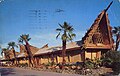 Bali Hai, New Orleans, 1959
 -
 Trader Vic's 1944 Mai Tai
 -
 Tiki Bar
 -
 Beachcomber Bar entrance, Butlins Ayr, 1985
.jpg)
.jpg)


