Marche: Difference between revisions
CSV import |
CSV import |
||
| Line 25: | Line 25: | ||
[[Category:Marche]] | [[Category:Marche]] | ||
{{Italy-stub}} | {{Italy-stub}} | ||
<gallery> | |||
File:Cingoli_BalconeDelleMarche.jpg|Cingoli, known as the "Balcony of the Marche" | |||
File:Sirolo-vista_conero.jpg|View of Sirolo and Monte Conero | |||
File:Anfiteatro_Urbs_Salvia.jpg|Amphitheater of Urbs Salvia | |||
File:Urbino-palazzo_e_borgo.jpg|Palace and town of Urbino | |||
File:Ancona_-_Duomo_di_San_Ciriaco_-_veduta_aerea.jpg|Aerial view of Ancona Cathedral, San Ciriaco | |||
File:Indesit_Headquarter.jpg|Indesit Headquarters | |||
</gallery> | |||
Latest revision as of 11:05, 18 February 2025
Marche is one of the twenty regions located in the central area of the country. It is bordered by Emilia-Romagna and the republic of San Marino to the north, Tuscany to the west, Umbria to the southwest, Abruzzo and Lazio to the south and the Adriatic Sea to the east. The region is named after the medieval March of Ancona and the March of Fermo, which covered the majority of the modern region.
History[edit]
The history of Marche dates back to the prehistoric era. The region was inhabited by the Picentes, an ancient Italic tribe, and later by the Romans. After the fall of the Western Roman Empire, Marche was invaded by the Goths and the Lombards. In the 11th century, the region was divided into two marches, the March of Ancona and the March of Fermo.
Geography[edit]
Marche extends over an area of 9,694 square kilometers and has a population of about 1.5 million people. The region is characterized by a wide range of landscapes, from the sandy beaches of the Adriatic coast to the high peaks of the Apennine Mountains. The region is also home to several national parks and nature reserves, including the Sibillini Mountains National Park and the Conero Regional Park.
Economy[edit]
The economy of Marche is diverse and balanced, with a mix of agriculture, industry, and services. The region is known for its production of wine, olive oil, and fruits. The industrial sector is dominated by small and medium-sized enterprises, particularly in the fields of footwear, clothing, and furniture. The service sector, including tourism, is also an important part of the regional economy.
Culture[edit]
Marche has a rich cultural heritage, with numerous historical towns and cities, museums, and art galleries. The region is famous for its Renaissance art and architecture, particularly in the cities of Urbino and Ascoli Piceno. Marche is also known for its traditional music and festivals, such as the Rossini Opera Festival in Pesaro and the Macerata Opera Festival.
See also[edit]

-
 Cingoli, known as the "Balcony of the Marche"
 -
 View of Sirolo and Monte Conero
 -
 Amphitheater of Urbs Salvia
 -
 Palace and town of Urbino
 -
 Aerial view of Ancona Cathedral, San Ciriaco
 -
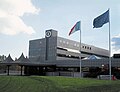 Indesit Headquarters


