Neuromuscular junction: Difference between revisions
CSV import Tags: mobile edit mobile web edit |
CSV import |
||
| Line 26: | Line 26: | ||
{{stub}} | {{stub}} | ||
<gallery> | |||
File:Neuro_Muscular_Junction.png|Neuromuscular junction diagram | |||
File:Neuromuscular_junction.svg|Neuromuscular junction illustration | |||
File:Neural_Control_(pre-muscle_contraction).png|Neural control before muscle contraction | |||
File:The_Muscle_Contraction_Process.png|The muscle contraction process | |||
File:Ion-Channel_Receptor.svg|Ion channel receptor | |||
File:Dr_Braun_Performs_a_Botox_Injection_(4035273577).jpg|Dr. Braun performs a Botox injection | |||
</gallery> | |||
Latest revision as of 11:05, 18 February 2025
Neuromuscular junction (NMJ), also known as the myoneural junction, is a synapse or junction of the motor neuron and muscle fiber. It is a part of the motor unit that translates nervous impulses from the brain or spinal cord into muscle movement.
Structure[edit]
The NMJ is composed of the presynaptic terminal of a motor neuron, the motor end plate of a muscle fiber, and the space between them known as the synaptic cleft. The presynaptic terminal contains synaptic vesicles that store the neurotransmitter acetylcholine (ACh), while the motor end plate contains nicotinic acetylcholine receptors (nAChRs) that bind to ACh.
Function[edit]
When an action potential reaches the presynaptic terminal, it triggers the release of ACh into the synaptic cleft. The ACh then binds to nAChRs on the motor end plate, causing an influx of sodium ions into the muscle fiber. This leads to a depolarization of the muscle fiber and ultimately results in muscle contraction.
Clinical significance[edit]
Disorders of the NMJ can lead to muscle weakness and fatigue. These include myasthenia gravis, a chronic autoimmune disease that causes muscle weakness and fatigue, and Lambert-Eaton syndrome, a rare autoimmune disorder that affects the NMJ.
See also[edit]
References[edit]
<references />
 | This medical article is a stub. You can help WikiMD by expanding the page. |
-
 Neuromuscular junction diagram
 -
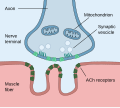 Neuromuscular junction illustration
 -
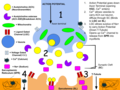 Neural control before muscle contraction
 -
 The muscle contraction process
 -
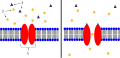 Ion channel receptor
 -
 Dr. Braun performs a Botox injection


.png)


.jpg)
