Gavriil Ilizarov: Difference between revisions
CSV import |
CSV import |
||
| Line 28: | Line 28: | ||
{{medicine-stub}} | {{medicine-stub}} | ||
<gallery> | |||
File:G.A._Ilisarow_(1991).jpg|Gavriil Ilizarov in 1991 | |||
File:Ilizarov2.jpg|Gavriil Ilizarov | |||
File:Küntscher-Nagel,_Ilisarow_(Grützke).jpg|Gavriil Ilizarov with Küntscher-Nagel | |||
File:Ilisarow-Fixateur_(Grützke).jpg|Ilizarov Fixateur | |||
File:DrIlizarovFragm.jpg|Gavriil Ilizarov | |||
File:Gavriil_Ilizarov_2021_stamp_of_Russia.jpg|Gavriil Ilizarov 2021 stamp of Russia | |||
</gallery> | |||
Latest revision as of 11:05, 18 February 2025
Gavriil Abramovich Ilizarov (Russian: Гаврии́л Абра́мович Илиза́ров; 15 June 1921 – 24 July 1992) was a Soviet physician, known for inventing the Ilizarov apparatus for lengthening limb bones and for his eponymous surgery, the Ilizarov surgery, used to treat complex and/or open bone fractures, and in orthopedic surgery for limb lengthening, and for the treatment of complex bone nonunions.
Early Life and Education[edit]
Gavriil Ilizarov was born in the Soviet Union in a small village in the Belarusian SSR. He completed his medical education at the Crimea Medical School in the midst of World War II, graduating in 1944. After his graduation, Ilizarov was assigned to a rural hospital in the Kurgan region of Siberia, where he would spend much of his professional life.
Career and Contributions[edit]
In the early 1950s, Ilizarov developed the principles of distraction osteogenesis to treat soldiers with limb injuries that he encountered in his practice. This technique involves the cutting of bone and the slow, mechanical induction of new bone growth between the two sections. To facilitate this process, Ilizarov invented the Ilizarov apparatus, a circular external fixator, in 1951.
Ilizarov's methods were initially met with skepticism within the Soviet medical community. However, his techniques gained international recognition in the 1960s and 1970s, following successful treatment of a well-known Soviet high jumper. This led to widespread adoption of his methods, both in the Soviet Union and internationally.
Ilizarov's work has had a profound impact on orthopedic surgery, particularly in the fields of limb lengthening and the treatment of complex fractures and nonunions. His methods have allowed for the correction of severe skeletal deformities and the salvaging of limbs that would otherwise have been amputated.
Legacy[edit]
Ilizarov's contributions to medicine have been recognized with numerous awards and honors, both in the Soviet Union and internationally. The Ilizarov Scientific Center for Restorative Traumatology and Orthopaedics in Kurgan, Russia, is named in his honor, continuing his work and research in orthopedics.
Despite his passing in 1992, Ilizarov's techniques and apparatus continue to be used and developed by orthopedic surgeons around the world, making a significant impact on the field of reconstructive surgery.
See Also[edit]

-
 Gavriil Ilizarov in 1991
 -
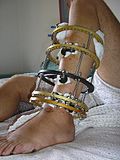 Gavriil Ilizarov
 -
 Gavriil Ilizarov with Küntscher-Nagel
 -
 Ilizarov Fixateur
 -
 Gavriil Ilizarov
 -
 Gavriil Ilizarov 2021 stamp of Russia
.jpg)

.jpg)
.jpg)


