Sisyrinchium: Difference between revisions
CSV import Tags: mobile edit mobile web edit |
CSV import |
||
| Line 33: | Line 33: | ||
{{Iridaceae-stub}} | {{Iridaceae-stub}} | ||
<gallery> | |||
File:Sisyrinchium_bermudianum_B.jpg|Sisyrinchium bermudianum | |||
File:Sisyrinchium_angustifolium_RHu_002.JPG|Sisyrinchium angustifolium | |||
File:Sisyrinchium_californicum_7.jpg|Sisyrinchium californicum | |||
File:Sisyrinchium_albidum.jpg|Sisyrinchium albidum | |||
File:Sisyrinchium-campestre.jpg|Sisyrinchium campestre | |||
File:Sisyrinchium-montanum.jpg|Sisyrinchium montanum | |||
File:Sisyrinchium-mucronatum.jpg|Sisyrinchium mucronatum | |||
File:Sisyrinchium-fuscatum.jpg|Sisyrinchium fuscatum | |||
</gallery> | |||
Latest revision as of 11:03, 18 February 2025
Sisyrinchium is a large genus of annual to perennial plants of the Iridaceae family, commonly known as blue-eyed grasses. Despite their common name, they are not true grasses but are more closely related to iris plants. The genus is native primarily to the Americas, with a wide distribution from Canada to Argentina, including diverse environments from temperate regions to the high Andes. Sisyrinchium species are known for their grass-like foliage and small, often star-shaped flowers that come in shades of blue, purple, white, and yellow.
Description[edit]
Sisyrinchium species are characterized by their clump-forming habit and slender, grass-like leaves. The flowers, which appear in spring and summer, are typically small and borne singly or in clusters at the stem tips. Each flower has six petal-like segments and a central yellow or sometimes blue to purple eye. The fruit is a capsule, usually containing black or brown seeds.
Taxonomy[edit]
The taxonomy of Sisyrinchium is complex and has been subject to revision. The genus was first described by Carl Linnaeus in 1753. It belongs to the family Iridaceae, subfamily Iridoideae. Within the genus, species are divided into various sections based on morphological characteristics such as flower color, leaf width, and plant height.
Habitat and Distribution[edit]
Sisyrinchium species are adaptable and can be found in a variety of habitats, including meadows, woodlands, and marshes. They prefer well-drained soils and can tolerate a range of light conditions, from full sun to partial shade. The wide distribution of the genus reflects its adaptability to different environmental conditions.
Cultivation and Uses[edit]
Some species of Sisyrinchium are cultivated as ornamental plants for their attractive flowers and foliage. They are suitable for use in rock gardens, borders, and as ground cover. These plants are generally low maintenance, requiring minimal care once established. They can also attract pollinators such as bees and butterflies to the garden.
Conservation[edit]
While many Sisyrinchium species are common and not considered at risk, some are rare and face threats from habitat destruction and other environmental pressures. Conservation efforts are important to protect these species and their natural habitats.
Selected Species[edit]
- Sisyrinchium angustifolium – Stout blue-eyed grass
- Sisyrinchium bellum – Western blue-eyed grass
- Sisyrinchium idahoense – Idaho blue-eyed grass
- Sisyrinchium montanum – Strict blue-eyed grass
See Also[edit]
References[edit]
<references/>

-
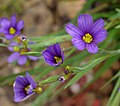 Sisyrinchium bermudianum
 -
 Sisyrinchium angustifolium
 -
 Sisyrinchium californicum
 -
 Sisyrinchium albidum
 -
 Sisyrinchium campestre
 -
 Sisyrinchium montanum
 -
 Sisyrinchium mucronatum
 -
 Sisyrinchium fuscatum


