Wetting: Difference between revisions
CSV import Tags: mobile edit mobile web edit |
CSV import |
||
| Line 30: | Line 30: | ||
{{stub}} | {{stub}} | ||
<gallery> | |||
File:A_water_droplet_DWR-coated_surface2_edit1.jpg|Wetting | |||
File:Contact_angle_schematic.svg|Contact angle schematic | |||
File:Surface_tension.svg|Surface tension | |||
File:3PhaseCoexistence.svg|Three-phase coexistence | |||
File:NeumannTriangle.svg|Neumann triangle | |||
File:Contact_angle.svg|Contact angle | |||
File:Diagram_droplets.tif|Diagram of droplets | |||
File:Cahysteresis(crop).jpg|Contact angle hysteresis | |||
File:Wenzel.png|Wenzel model | |||
File:Cassie-Baxter.png|Cassie-Baxter model | |||
File:Petal_lotus.JPG|Lotus effect | |||
File:Cassie_transition.png|Cassie transition | |||
</gallery> | |||
Latest revision as of 11:03, 18 February 2025
Wetting is the ability of a liquid to maintain contact with a solid surface, resulting from intermolecular interactions when the two are brought together. The degree of wetting (wettability) is determined by a force balance between adhesive and cohesive forces.
Wetting in Nature[edit]
Wetting is important in the bonding or adherence of two materials. Wetting and the surface forces that control wetting are also responsible for the shape of liquid droplets on a solid surface, such as rain drops on leaves.
Wetting in Technology[edit]
In industrial processes, wetting is important in many areas such as painting, printing, cleaning, and in the performance of certain types of chemical reactions. Wetting is also critical in the field of surface science, in regards to microfluidics, nanofluidics, and metallurgy.
Wetting Agents[edit]
A wetting agent is a surface-active molecule used to reduce the surface tension of water. A wetting agent spreads water on a surface, increasing the ability of water to spread and the ability of a liquid to penetrate into the interior of a solid.
Wetting Phenomena[edit]
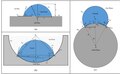
Wetting phenomena are generally classified into different types such as total wetting, partial wetting, and non-wetting based on the contact angle.
See Also[edit]
References[edit]
<references />


.jpg)


