GABAA receptor: Difference between revisions
CSV import |
CSV import |
||
| Line 28: | Line 28: | ||
[[Category:Neurotransmitter receptors]] | [[Category:Neurotransmitter receptors]] | ||
[[Category:GABA]] | [[Category:GABA]] | ||
<gallery> | |||
File:Fig-GABAA_receptor.png|GABAA receptor structure | |||
File:GABAA_receptor_schematic.png|Schematic of GABAA receptor | |||
File:GABAA-receptor-protein-example-en.svg|GABAA receptor protein example | |||
File:6x3v_GABAA-Rezeptorstruktur.png|GABAA receptor structure | |||
File:GABAa_receptor.gif|GABAA receptor | |||
File:6X3Z_GABAAR_GABA.png|GABAA receptor with GABA | |||
</gallery> | |||
Latest revision as of 10:57, 18 February 2025
GABAA receptor is a type of protein that responds to the neurotransmitter gamma-aminobutyric acid (GABA), which is the chief inhibitory compound in the mature vertebrate central nervous system. GABAA receptors are members of the ligand-gated ion channel superfamily.
Structure[edit]
The GABAA receptor is a multimeric transmembrane receptor that consists of five subunits arranged around a central pore. Each subunit comprises four transmembrane domains with both the N- and C-terminus located extracellularly. The receptor sits in the membrane of its neuron, usually localized at a synapse, postsynaptically.
Function[edit]
GABAA receptors occur in all organisms that have a nervous system. To a limited extent the receptors can be found in non-neuronal tissues. Due to their wide distribution within the nervous system of mammals they play a role in virtually all brain functions.
When an action potential reaches the neuron at the synapse, it causes or inhibits the release of GABA into the synapse. GABA then binds to GABAA receptors on the postsynaptic neuron and causes an influx of negative (chloride) ions into the neuron, making the postsynaptic membrane potential more negative, and thus inhibits the neuron from firing an action potential.
Pharmacology[edit]
GABAA receptors are the targets of several classes of drugs, including benzodiazepines, barbiturates, and alcohols. These drugs bind to the GABAA receptor at distinct allosteric binding sites which are not the same as GABA itself and also modulate the receptor's activation and desensitization kinetics.
See also[edit]
References[edit]
<references />

This article is a neuroscience stub. You can help WikiMD by expanding it!
-
 GABAA receptor structure
 -
 Schematic of GABAA receptor
 -
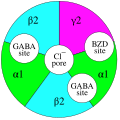 GABAA receptor protein example
 -
 GABAA receptor structure
 -
 GABAA receptor
 -
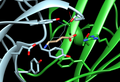 GABAA receptor with GABA


