Articulatory phonetics: Difference between revisions
CSV import |
CSV import |
||
| Line 41: | Line 41: | ||
[[Category:Nuclear reactors]] | [[Category:Nuclear reactors]] | ||
[[Category:Nuclear technology]] | [[Category:Nuclear technology]] | ||
== Articulatory_phonetics == | |||
<gallery> | |||
File:Phonological_anatomy_1.png|Phonological anatomy diagram | |||
File:Diagram_showing_the_parts_of_the_pharynx_CRUK_334.svg|Diagram showing the parts of the pharynx | |||
File:Places_of_articulation.svg|Places of articulation | |||
File:Larynx_external_en.svg|External view of the larynx | |||
File:Real-time_MRI_-_Speaking_(English).ogv|Real-time MRI of speaking | |||
</gallery> | |||
Revision as of 05:05, 18 February 2025
Type of nuclear reactor
Aqueous homogeneous reactors (AHRs) are a type of nuclear reactor in which the nuclear fuel is dissolved in water, forming a homogeneous solution. This design contrasts with other reactor types where the fuel is in solid form. AHRs are a subset of homogeneous reactors, which are characterized by having the fuel and moderator mixed together in a single phase.
Design and Operation
Aqueous homogeneous reactors typically use uranium or plutonium salts dissolved in water as the fuel. The water acts both as a neutron moderator and a coolant. The reactor core is essentially a tank filled with this solution, and the nuclear reaction occurs throughout the entire volume of the solution.
The homogeneous nature of the fuel solution allows for a uniform distribution of the nuclear reaction, which can lead to more efficient use of the fuel. The reactor is usually operated at low pressures and temperatures compared to other reactor types, which can simplify the design and reduce the risk of certain types of accidents.
Advantages
Aqueous homogeneous reactors have several advantages:
- Simplicity of Design: The lack of solid fuel elements simplifies the reactor design and eliminates the need for complex fuel fabrication processes.
- Efficient Fuel Use: The homogeneous mixture allows for a more complete burn-up of the nuclear fuel, potentially reducing waste.
- Ease of Refueling: The liquid fuel can be easily processed and refueled without the need to shut down the reactor.
Disadvantages
Despite their advantages, AHRs also have significant challenges:
- Corrosion: The presence of water and dissolved salts can lead to corrosion of reactor components.
- Radiolysis: The interaction of radiation with water can produce gases such as hydrogen and oxygen, which need to be managed to prevent explosive mixtures.
- Limited Power Output: AHRs are generally limited to low power outputs, making them unsuitable for large-scale power generation.
Applications
Aqueous homogeneous reactors have been used primarily for research purposes and the production of medical isotopes. Their ability to produce a high neutron flux in a small volume makes them ideal for these applications.
History
The concept of homogeneous reactors dates back to the early days of nuclear research. The first AHRs were developed in the 1940s and 1950s as part of the Manhattan Project and subsequent research programs. The Oak Ridge National Laboratory (ORNL) in the United States was a key site for the development and testing of these reactors.
Gallery
-
 Aqueous homogeneous reactor at ORNL
 -
 Cutaway view of a homogeneous reactor


Related pages
Articulatory_phonetics
-
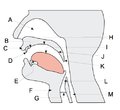 Phonological anatomy diagram
 -
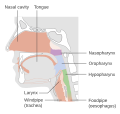 Diagram showing the parts of the pharynx
 -
 Places of articulation
 -
External view of the larynx
-
 Real-time MRI of speaking


