Pop out cake: Difference between revisions
CSV import Tags: mobile edit mobile web edit |
CSV import |
||
| Line 20: | Line 20: | ||
{{food-stub}} | {{food-stub}} | ||
<gallery> | |||
File:The_Girl-in-the-pie_Dinner,_Ehrhart._LCCN2010652264_(cropped).jpg|The Girl in the Pie Dinner | |||
File:The_Girl_in_the_Pie_from_The_World_October_13_1895.png|The Girl in the Pie from The World, October 13, 1895 | |||
File:Dan_Hadani_collection_(990044445940205171).jpg|Pop out cake | |||
File:Girl-in-the-pie_illustration.jpg|Girl in the Pie Illustration | |||
</gallery> | |||
Latest revision as of 05:02, 18 February 2025
Pop out cake or jump out cake is a large baked cake that is designed to serve as a surprise gimmick for a party or event. The cake is large enough to hold a person inside, who can then 'pop out' of the cake to the surprise of the guests. This concept has been popularized in various forms of media and is often associated with bachelor parties, birthday parties, or other celebratory events.
History[edit]
The concept of a pop out cake dates back to the early 20th century. It was initially used in vaudeville shows and later became a popular gimmick in burlesque performances. The idea was to surprise the audience with an unexpected person, often a woman, jumping out of a seemingly real cake.
Design and Construction[edit]
A pop out cake is not a traditional cake. It is typically made from a lightweight material such as cardboard or foam, and then decorated to look like a real cake. The inside of the cake is hollow and contains a hidden compartment where a person can hide. The top of the cake is designed to be easily removable, allowing the person inside to 'pop out' at the appropriate moment.
Cultural Significance[edit]
Pop out cakes have been featured in numerous films, television shows, and other forms of media, often for comedic effect. They are also a popular feature at bachelor parties and other adult-themed events. Despite their association with adult entertainment, pop out cakes have also been used in more family-friendly settings, such as children's birthday parties.
See Also[edit]

-
 The Girl in the Pie Dinner
 -
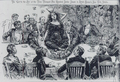 The Girl in the Pie from The World, October 13, 1895
 -
 Pop out cake
 -
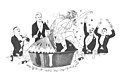 Girl in the Pie Illustration
.jpg)

.jpg)

