Loess: Difference between revisions
CSV import Tags: mobile edit mobile web edit |
CSV import Tags: mobile edit mobile web edit |
||
| Line 26: | Line 26: | ||
[[Category:Geology]] | [[Category:Geology]] | ||
{{Geology-stub}} | {{Geology-stub}} | ||
<gallery> | |||
File:LoessVicksburg.jpg|Loess in Vicksburg | |||
File:Loess_landscape_china.jpg|Loess landscape in China | |||
File:Löss_1.jpg|Loess formation | |||
File:Luvos_Heilerde.jpg|Loess as healing earth | |||
File:Distribution_of_loess_in_North_America.gif|Distribution of loess in North America | |||
File:ArgentinaLoess.JPG|Loess in Argentina | |||
</gallery> | |||
Latest revision as of 05:01, 18 February 2025
Loess is a type of soil made up of small particles that have been transported by the wind. It is a sedimentary deposit that is highly susceptible to erosion. Loess is found in many parts of the world, including the United States, China, and Europe.
Formation[edit]
Loess is formed by the accumulation of wind-blown silt, typically in the 20–50 micrometer size range, twenty percent or less clay and the balance equal parts sand and silt that are loosely cemented by calcium carbonate. It is usually homogeneous and highly porous and is traversed by vertical capillaries that permit the sediment to fracture and form vertical bluffs.
Distribution[edit]
The largest deposit of loess in the United States, the Loess Hills along the border of Iowa and Nebraska, has survived intensive farming and poor farming practices. In Europe, the Loess Belt stretches from southern Ukraine and Moldova toward the east around the southern part of the Carpathian Mountains to Romania and Bulgaria.
Properties[edit]
Loess is a highly erodible soil that is often the result of wind deposition. This type of soil is defined by its high mineral content, particularly quartz, feldspar, mica, and other minerals. The mineral content of loess is uniform throughout, making it distinct from other soil types that have distinct layers of different types of soil particles.
Uses[edit]
Loess soil is highly fertile, which makes it valuable for farming. It has been used for agricultural purposes for thousands of years. In addition, loess has been used in construction. In China, for example, many buildings, walls, and other structures have been built out of loess brick.
See also[edit]
References[edit]
<references />
 | This geology article is a stub. You can help Wikipedia by adding missing information. |
-
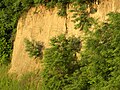 Loess in Vicksburg
 -
 Loess landscape in China
 -
 Loess formation
 -
 Loess as healing earth
 -
 Distribution of loess in North America
 -
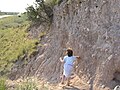 Loess in Argentina


