Armagnac: Difference between revisions
CSV import |
CSV import Tags: mobile edit mobile web edit |
||
| Line 50: | Line 50: | ||
[[Category:Flora of North America]] | [[Category:Flora of North America]] | ||
[[Category:Medicinal plants]] | [[Category:Medicinal plants]] | ||
<gallery> | |||
File:Armagnac-img_0465.jpg|Armagnac | |||
File:Vignoble_d'Armagnac.JPG|Vineyards of Armagnac | |||
File:The_Armagnac_Region,_France.jpg|The Armagnac Region, France | |||
File:Arthez_alambic_Ognoas_1936.jpg|Alambic Ognoas 1936 | |||
File:Arthez_alambic_Ognoas_1804.jpg|Alambic Ognoas 1804 | |||
</gallery> | |||
Revision as of 05:01, 18 February 2025
Species of flowering plant
Apocynum androsaemifolium, commonly known as spreading dogbane or fly-trap dogbane, is a species of flowering plant in the dogbane family (Apocynaceae). It is native to North America, where it is found in a variety of habitats, including woodlands, meadows, and roadsides.
Description
Apocynum androsaemifolium is a perennial herbaceous plant that typically grows to a height of 30 to 100 cm. The plant has slender, branching stems that exude a milky latex when broken. The leaves are opposite, simple, and ovate to lanceolate in shape, with a smooth margin and a pointed tip. They are typically 3 to 10 cm long and 1 to 4 cm wide.
The flowers of A. androsaemifolium are small, bell-shaped, and pink to white in color. They are arranged in loose, terminal clusters. Each flower has five petals that are fused at the base, forming a tube. The flowering period is from late spring to mid-summer.
Distribution and Habitat
Apocynum androsaemifolium is widely distributed across North America, from Canada to the United States. It thrives in a variety of habitats, including open woods, thickets, and along roadsides. The plant prefers well-drained soils and can often be found in sandy or rocky areas.
Ecology
The flowers of A. androsaemifolium are pollinated by insects, particularly bees and butterflies. The plant is known for its ability to trap small insects with its sticky latex, which may contribute to its common name, "fly-trap dogbane."
Apocynum androsaemifolium is also a host plant for the larvae of certain butterfly species, including the dogbane tiger moth (Cycnia tenera).
Toxicity
All parts of Apocynum androsaemifolium contain toxic compounds, including cardiac glycosides, which can be harmful if ingested. The plant's milky latex can cause skin irritation in some individuals.
Uses
Historically, Native American tribes used A. androsaemifolium for various medicinal purposes, including as a treatment for heart conditions and as a laxative. However, due to its toxicity, caution is advised in its use.
Related pages
Gallery
-
 Apocynum androsaemifolium in bloom

-
 Armagnac
 -
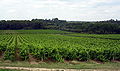 Vineyards of Armagnac
 -
 The Armagnac Region, France
 -
 Alambic Ognoas 1936
 -
 Alambic Ognoas 1804


