Golden Age of Piracy: Difference between revisions
CSV import |
CSV import |
||
| Line 53: | Line 53: | ||
[[Category:18th century]] | [[Category:18th century]] | ||
[[Category:Maritime history]] | [[Category:Maritime history]] | ||
<gallery> | |||
File:Amaro_Pargo.jpg|Amaro Pargo, a famous Spanish pirate | |||
File:Pg_003_-_Engraving_(bw).jpg|Engraving depicting a pirate scene | |||
File:Blackbeard_head_bow.gif|Blackbeard, the notorious pirate | |||
File:Cornelis_Vroom_Spanish_Men_of_War_Engaging_Barbary_Corsairs.jpg|Spanish Men of War Engaging Barbary Corsairs by Cornelis Vroom | |||
</gallery> | |||
Latest revision as of 05:00, 18 February 2025
Golden Age of Piracy[edit]
The Golden Age of Piracy is a term used to describe a period in the late 17th and early 18th centuries when maritime piracy was at its height. This era is characterized by the activities of notorious pirates such as Blackbeard, Bartholomew Roberts, and Captain Kidd. The Golden Age of Piracy is often romanticized in popular culture, but it was a time of significant impact on maritime trade and colonial expansion.
Historical Context[edit]
The Golden Age of Piracy occurred during a time of great change in the world. The Age of Exploration had opened up new trade routes and colonies, and European powers were competing for dominance. The War of the Spanish Succession (1701–1714) left many sailors unemployed, leading some to turn to piracy.
Economic Factors[edit]
The expansion of trade routes between the New World, Africa, and Europe created opportunities for pirates to attack merchant ships. The Spanish Treasure Fleet, which transported gold and silver from the Americas to Spain, was a particularly lucrative target.
Political Factors[edit]
The lack of strong naval presence in the Caribbean and the Americas allowed piracy to flourish. Many colonial governors were either unable or unwilling to combat piracy, and some even colluded with pirates for personal gain.
Notable Pirates[edit]
Blackbeard[edit]
Edward Teach, better known as Blackbeard, was one of the most feared pirates of the Golden Age. He commanded the ship Queen Anne's Revenge and was known for his intimidating appearance and ruthless tactics.
Bartholomew Roberts[edit]
Bartholomew Roberts, also known as Black Bart, captured over 400 ships during his career. He was known for his strict code of conduct and his ability to evade capture.
Captain Kidd[edit]
William Kidd was initially commissioned as a privateer but turned to piracy. His trial and execution were highly publicized, contributing to his notoriety.
Pirate Havens[edit]
Pirates established bases in strategic locations where they could easily intercept trade routes. Notable pirate havens included:
- Nassau in the Bahamas
- Port Royal in Jamaica
- Tortuga off the coast of Hispaniola
End of the Golden Age[edit]
The Golden Age of Piracy began to decline in the 1720s due to several factors:
- Increased naval patrols by the Royal Navy and other European powers
- The establishment of stronger colonial governments
- The use of pirate hunters and the offering of pardons to pirates who surrendered
Legacy[edit]
The Golden Age of Piracy has left a lasting legacy in popular culture, inspiring countless books, films, and legends. The romanticized image of pirates as swashbuckling adventurers continues to captivate the public imagination.
See Also[edit]
References[edit]
- Cordingly, David. Under the Black Flag: The Romance and the Reality of Life Among the Pirates. Random House, 1995.
- Konstam, Angus. Pirates: The Complete History from 1300 BC to the Present Day. Osprey Publishing, 2008.
-
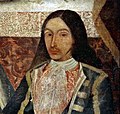 Amaro Pargo, a famous Spanish pirate
 -
 Engraving depicting a pirate scene
 -
 Blackbeard, the notorious pirate
 -
 Spanish Men of War Engaging Barbary Corsairs by Cornelis Vroom

.jpg)


