Ginger ale: Difference between revisions
CSV import Tags: mobile edit mobile web edit |
CSV import |
||
| Line 18: | Line 18: | ||
[[Category:Non-alcoholic beverages]] | [[Category:Non-alcoholic beverages]] | ||
{{food-stub}} | {{food-stub}} | ||
<gallery> | |||
File:Vernors_ginger_ale.jpg|Vernors Ginger Ale | |||
File:Canada_Dry_Pale_Ginger_Ale_Toronto_Star_ad_1916.jpg|Canada Dry Pale Ginger Ale Toronto Star ad 1916 | |||
File:Yeast_and_nutrients.JPG|Yeast and nutrients | |||
File:8_Gläser_Ginger_Ale.jpg|8 Glasses of Ginger Ale | |||
File:Ginger_ale_bottles.jpg|Ginger Ale bottles | |||
</gallery> | |||
Latest revision as of 05:00, 18 February 2025
Ginger ale is a carbonated soft drink flavored primarily with ginger and sweetened with sugar or high-fructose corn syrup. Originating in the mid-19th century, ginger ale was first used as a medicinal tonic for digestive issues, nausea, and other ailments. Today, it is widely consumed for both its refreshing taste and its traditional health benefits. There are two main types of ginger ale: the golden style, which is strong and spicy, and the dry style, which is lighter in taste and more carbonated.
History[edit]
The history of ginger ale can be traced back to the 1800s in Ireland and England, where it was concocted in apothecaries and small soda shops as a digestive aid and homemade remedy. The drink gained popularity in the United States and Canada by the late 19th century, with brands like Canada Dry and Vernors leading the market. Canada Dry introduced the "dry" style of ginger ale in 1904, which quickly became popular in North America and beyond.
Production[edit]
The production of ginger ale involves carbonating water and adding sugar and natural or artificial ginger flavorings. Some manufacturers also include lemon, lime, or cane sugar to enhance the flavor profile. The golden style may contain actual ginger pulp or extract, giving it a more robust flavor and slightly cloudy appearance. In contrast, the dry style focuses on a clean, crisp taste with a lighter ginger flavor.
Health Benefits[edit]
Ginger ale is often touted for its health benefits, especially in aiding digestion and relieving nausea. Ginger, the primary flavoring agent, has been used in traditional medicine for centuries to treat stomach upset, diarrhea, and nausea. While commercial ginger ales may contain only a minimal amount of ginger, some people still find the drink soothing for mild stomach discomfort.
Culinary Uses[edit]
Beyond its role as a beverage, ginger ale is also used in culinary applications. It serves as a mixer in cocktails, a flavorful addition to smoothies, and a tenderizing marinade for meats. Its sweet and spicy profile can enhance a variety of recipes, from desserts to savory dishes.
Brands and Varieties[edit]
Several brands of ginger ale are available on the market, each offering its unique take on the classic flavor. Some of the most well-known brands include Canada Dry, Vernors, and Schweppes. Artisanal and craft ginger ales have also gained popularity, with smaller producers emphasizing natural ingredients and traditional brewing methods.
See Also[edit]

-
 Vernors Ginger Ale
 -
 Canada Dry Pale Ginger Ale Toronto Star ad 1916
 -
 Yeast and nutrients
 -
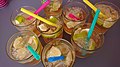 8 Glasses of Ginger Ale
 -
 Ginger Ale bottles


