CREB-binding protein: Difference between revisions
CSV import Tags: mobile edit mobile web edit |
CSV import |
||
| Line 26: | Line 26: | ||
{{protein-stub}} | {{protein-stub}} | ||
{{gene-stub}} | {{gene-stub}} | ||
<gallery> | |||
File:CBP_Domains.jpg|CREB-binding protein domains | |||
File:3P1CBromodomainofCBPHumanProtein.png|3P1C Bromodomain of CBP Human Protein | |||
File:Sequence_Homology_Between_CBP_and_p300.jpg|Sequence Homology Between CBP and p300 | |||
File:CBP_and_the_Cell_Cycle.jpg|CBP and the Cell Cycle | |||
File:CBP_Bcat_Transcription_Figure.jpg|CBP Bcat Transcription Figure | |||
</gallery> | |||
Latest revision as of 04:59, 18 February 2025
CREB-binding protein (CBP) is a protein that in humans is encoded by the CREBBP gene. CBP and its closely related family member p300 are well known as transcriptional coactivators involved in various cellular processes, including cell growth, differentiation, and apoptosis, through the interaction with a variety of transcription factors.
Function[edit]
CBP and p300 have histone acetyltransferase (HAT) activity, which allows them to acetylate histones and other proteins. This acetylation can loosen the structure of chromatin, thereby promoting gene transcription. In addition to their HAT activity, CBP and p300 can also act as a bridge to bring together other proteins needed for the transcription process.
Clinical significance[edit]
Mutations in the CREBBP gene are associated with Rubinstein-Taybi syndrome, a rare genetic disorder characterized by mental retardation, growth retardation, and distinctive facial features. In addition, CBP is often targeted by viral proteins and is involved in the pathogenesis of several types of cancer.
See also[edit]
References[edit]


-
 CREB-binding protein domains
 -
 3P1C Bromodomain of CBP Human Protein
 -
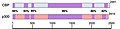 Sequence Homology Between CBP and p300
 -
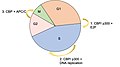 CBP and the Cell Cycle
 -
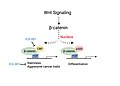 CBP Bcat Transcription Figure


