Dahi (curd): Difference between revisions
CSV import |
CSV import |
||
| Line 27: | Line 27: | ||
[[Category:Indian cuisine]] | [[Category:Indian cuisine]] | ||
{{food-stub}} | {{food-stub}} | ||
<gallery> | |||
File:Curd_in_a_traditional_Manipuri_earthen_pot.JPG|Curd in a traditional Manipuri earthen pot | |||
File:Curd_and_treacle.jpg|Curd and treacle | |||
File:Cucumber-raita.jpg|Cucumber raita | |||
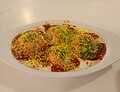
File:Dahi_puri,_Doi_phuchka.jpg|Dahi puri, Doi phuchka | |||
File:Dahi_Vada,_a_popular_South_Indian_dish,_photographed_in_Avani_Riverside_Mall,_Howrah,_West_Bengal,_India,_April_16,_2024.jpg|Dahi Vada, a popular South Indian dish | |||
</gallery> | |||
Latest revision as of 04:58, 18 February 2025
Dahi (also known as curd in English) is a dairy product that is widely consumed in various parts of the world, particularly in South Asia. It is a type of fermented milk product, similar to yogurt, but with a unique taste and texture that sets it apart.
History[edit]
The history of dahi dates back to ancient times. It is believed to have originated in the Indian subcontinent, where it has been consumed for thousands of years. The process of making dahi involves the natural fermentation of milk, which is facilitated by the presence of certain types of bacteria. This process has been refined over the centuries, but the basic principles remain the same.
Production[edit]
The production of dahi involves the fermentation of milk. This is typically achieved by adding a small amount of pre-existing dahi to fresh milk, which introduces the necessary bacteria to start the fermentation process. The milk is then left at a warm temperature for several hours, during which time the bacteria multiply and convert the lactose in the milk into lactic acid. This results in the characteristic tangy flavor of dahi, as well as its thick, creamy texture.
Nutritional Value[edit]
Dahi is highly nutritious, providing a good source of protein, calcium, and vitamin B12. It is also rich in probiotics, which are beneficial bacteria that can support digestive health. In addition, dahi is often recommended as a healthier alternative to cream or mayonnaise in various recipes, due to its lower fat and calorie content.
Uses[edit]
Dahi is used in a wide variety of culinary applications. In Indian cuisine, it is a key ingredient in many dishes, such as raita, dahi vada, and dahi bhalla. It is also used in the preparation of various types of curry, as well as in the marination of meats. In addition to its culinary uses, dahi is also used in certain religious rituals and ceremonies in the Indian subcontinent.
See Also[edit]

-
Curd in a traditional Manipuri earthen pot
-
Curd and treacle
-
Cucumber raita
-
 Dahi puri, Doi phuchka
 -
 Dahi Vada, a popular South Indian dish


