Tapai: Difference between revisions
CSV import Tags: mobile edit mobile web edit |
CSV import |
||
| Line 34: | Line 34: | ||
[[Category:Traditional food]] | [[Category:Traditional food]] | ||
{{Food-stub}} | {{Food-stub}} | ||
<gallery> | |||
File:Tapai_peuyeum_Pasar_Baru.JPG|Tapai | |||
File:Merienda_with_tapuy_and_biko.jpg|Tapai | |||
File:Peuyeum.jpg|Tapai | |||
File:Tape_Kng_070609_230_tdp.jpg|Tapai | |||
File:Es_Doger_1.JPG|Tapai | |||
File:Tapay_Maguindanao.jpg|Tapai | |||
</gallery> | |||
Latest revision as of 04:58, 18 February 2025
Tapai (also spelled tapay or tape), is a traditional fermented food found throughout much of East- and Southeast Asia. It is a sweet or sour alcoholic paste and a rich source of vitamin B. The fermentation process involves a variety of yeast and lactic acid bacteria, which contribute to the unique flavor, texture, and aroma of the product.
History[edit]
The origins of tapai are unclear, but it is believed to have been developed independently in various regions of Asia. It is a traditional food in many cultures, and is often associated with festive occasions and rituals.
Production[edit]
The production of tapai involves the fermentation of starch-rich foods such as rice, corn, and root crops. The process begins with the preparation of the raw materials, which are soaked, cooked, and cooled. The cooled material is then inoculated with a starter culture, typically a mixture of yeast and lactic acid bacteria. The inoculated material is packed into containers and allowed to ferment for several days to weeks.
During fermentation, the microorganisms break down the starches into sugars, which are then converted into alcohol and lactic acid. The result is a sweet or sour paste with a distinctive aroma and flavor.
Varieties[edit]
There are many varieties of tapai, each with its own unique characteristics. These include:
- Tapai Pulut: A type of tapai made from glutinous rice. It is popular in Malaysia and Indonesia.
- Tapai Ubi: A variety made from cassava. It is common in the Philippines and Indonesia.
- Tapai Nasi: A variety made from non-glutinous rice. It is popular in Malaysia and Indonesia.
Consumption[edit]
Tapai is typically consumed as a snack or dessert. It can be eaten on its own, or used as an ingredient in other dishes. In some cultures, it is also used as a medicinal food, believed to aid digestion and improve health.
See also[edit]

-
 Tapai
Tapai -
 Tapai
Tapai -
 Tapai
Tapai -
 Tapai
Tapai -
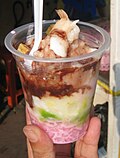 Tapai
Tapai -
Tapai


