Camping food: Difference between revisions
CSV import Tags: mobile edit mobile web edit |
CSV import Tags: mobile edit mobile web edit |
||
| Line 37: | Line 37: | ||
{{food-stub}} | {{food-stub}} | ||
== Camping_food == | |||
<gallery> | |||
File:Outdoor_(27465804456).jpg|Camping food setup in the outdoors | |||
File:Camping_food_outdoor.jpg|Various camping food items | |||
File:Freeze-dried_bacon_bars.jpg|Freeze-dried bacon bars | |||
File:MRE_contents.jpg|Contents of a Meal, Ready-to-Eat (MRE) | |||
File:Ijzeren_kookpot_(cropped).jpg|Iron cooking pot | |||
</gallery> | |||
Latest revision as of 04:58, 18 February 2025
Camping food refers to the type of food specifically prepared and packaged to be easily transported, stored, and consumed during outdoor camping trips. The nature of camping food ranges from simple, ready-to-eat items to ingredients intended for cooking over a campfire or portable camping stove. The primary considerations for camping food include weight, perishability, nutritional value, and ease of preparation.
Types of Camping Food[edit]
Camping food can be categorized into several types, each suited to different camping styles and durations.
Dehydrated and Freeze-Dried Foods[edit]
Dehydrated food and freeze-dried food are popular among backpackers and long-term campers due to their lightweight and long shelf life. Water is removed from the food, significantly reducing its weight and preventing the growth of microorganisms that cause spoilage. Campers rehydrate these meals with boiling water before consumption.
Ready-to-Eat Meals[edit]
Ready-to-eat meals, such as canned goods, energy bars, and trail mix, are convenient for short trips and emergency rations. They require no preparation, making them ideal for on-the-go consumption.
Snacks[edit]
Snacks like nuts, dried fruits, jerky, and granola bars are high in energy and nutrients, making them perfect for quick refueling during hiking or activities.
Fresh Foods[edit]
While not as common due to their weight and perishability, some campers opt to bring fresh foods for shorter trips. Items like fruits, vegetables, and eggs can be packed in coolers to maintain freshness.
Preparation and Storage[edit]
Proper preparation and storage are crucial to ensure food safety and minimize environmental impact. Campers should plan meals in advance, considering the trip's duration and the availability of cooking facilities. Food should be packed in waterproof containers and kept in coolers if necessary to prevent spoilage. It's also important to practice Leave No Trace principles by packing out all trash and leftovers.
Cooking Methods[edit]
Camping food can be cooked using various methods, depending on the campsite facilities and equipment available. Common cooking methods include:
- Campfire cooking, which involves preparing food over an open fire. This method requires knowledge of fire safety and cooking techniques.
- Using a portable stove or camping stove, which offers more control over cooking temperature and is safer in areas with fire restrictions.
- No-cook meals, which are ideal for areas where fires are not allowed or for campers seeking to minimize preparation time.
Nutritional Considerations[edit]
When selecting camping food, it's important to consider nutritional needs. Camping activities often require high energy expenditure, making it crucial to consume sufficient calories, proteins, and carbohydrates. Hydration is also key, so campers should plan to bring or purify enough water for drinking and cooking.
Environmental Considerations[edit]
Choosing environmentally friendly camping food involves selecting products with minimal packaging, opting for locally sourced and organic options when possible, and avoiding leaving any waste behind. Campers should also be mindful of wildlife by storing food securely and disposing of waste properly.

Camping_food[edit]
-
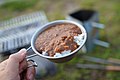 Camping food setup in the outdoors
 -
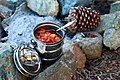 Various camping food items
 -
 Freeze-dried bacon bars
 -
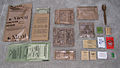 Contents of a Meal, Ready-to-Eat (MRE)
 -
 Iron cooking pot
.jpg)


.jpg)
