Smilax ornata: Difference between revisions
CSV import |
CSV import Tags: mobile edit mobile web edit |
||
| Line 38: | Line 38: | ||
[[Category:Medicinal plants]] | [[Category:Medicinal plants]] | ||
[[Category:Smilacaceae]] | [[Category:Smilacaceae]] | ||
<gallery> | |||
File:Sarsaparilla-1271142_1920.jpg|Smilax ornata plant | |||
File:Sarsaparilla-Triterpenes.svg|Chemical structure of triterpenes in Smilax ornata | |||
File:Sarsaparilloside.svg|Structure of Sarsaparilloside | |||
File:Sarsaparilla-R1.svg|Chemical structure R1 | |||
File:Sarsaparilla-R2.svg|Chemical structure R2 | |||
File:Parillin.svg|Structure of Parillin | |||
</gallery> | |||
Latest revision as of 04:57, 18 February 2025
Smilax ornata[edit]
Smilax ornata, also known as sarsaparilla, is a perennial, trailing vine with prickly stems that is native to Mexico and Central America. It is a member of the Smilacaceae family and is known for its medicinal properties.
Description[edit]
Smilax ornata is a climbing plant that can reach up to 50 meters in length. It has heart-shaped leaves and small greenish flowers. The plant produces small, black, blue, or red berries. The root of the Smilax ornata is long and tuberous, and it is this part of the plant that is used for its medicinal properties.
Medicinal Uses[edit]
Smilax ornata has been used in traditional medicine for centuries. The root is used to make sarsaparilla, a beverage that was popular in the United States in the 19th century. Sarsaparilla is believed to have anti-inflammatory and liver-protecting effects. It has also been used to treat skin diseases, rheumatoid arthritis, and kidney disease.
Cultivation[edit]
Smilax ornata prefers a well-drained soil and can grow in both light (sandy) and medium (loamy) soils. It can grow in semi-shade (light woodland) or no shade. It requires moist soil. The plant can tolerate strong winds but not maritime exposure.
Conservation Status[edit]
Smilax ornata is not currently listed on the IUCN Red List of Threatened Species. However, due to its medicinal uses, it is often harvested from the wild, which could potentially lead to overexploitation.
See Also[edit]
References[edit]
- Flora of North America (vol. 26)
- The Plant List (version 1.1)
- Plants For A Future (PFAF.org)
External Links[edit]
-
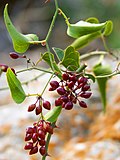 Smilax ornata plant
 -
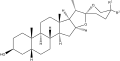 Chemical structure of triterpenes in Smilax ornata
 -
 Structure of Sarsaparilloside
 -
 Chemical structure R1
 -
 Chemical structure R2
 -
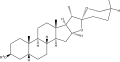 Structure of Parillin


