Francis Preston Blair Jr.: Difference between revisions
CSV import |
CSV import |
||
| Line 52: | Line 52: | ||
[[Category:1875 deaths]] | [[Category:1875 deaths]] | ||
{{US-Senator-stub}} | {{US-Senator-stub}} | ||
<gallery> | |||
File:General_Francis_Preston_Blair.jpg|Francis Preston Blair Jr. in military uniform | |||
File:Union_Army_major_general_rank_insignia.svg|Union Army major general rank insignia | |||
File:Francis_Preston_Blair,_Jr._and_staff_-_Brady-Handy.jpg|Francis Preston Blair Jr. and staff | |||
File:Francis_Preston_Blair_Jr.jpg|Portrait of Francis Preston Blair Jr. | |||
File:22-26-001-blair.jpg|Francis Preston Blair Jr. | |||
</gallery> | |||
Latest revision as of 04:57, 18 February 2025
Francis Preston Blair Jr. (February 19, 1821 – July 8, 1875) was an American lawyer, politician, and soldier. He represented Missouri in both the United States House of Representatives and the United States Senate, and he played a significant role in the politics of the American Civil War era.
Early Life and Education[edit]
Born in Lexington, Kentucky, Blair was part of the influential Blair family. His father, Francis Preston Blair Sr., was a prominent journalist and advisor to several U.S. presidents. Blair Jr. attended Princeton University, where he graduated in 1841. After completing his education, he moved to St. Louis, Missouri, where he practiced law and entered into politics.
Political Career[edit]
Blair was initially a member of the Democratic Party and was elected to the U.S. House of Representatives in 1856. During his tenure, he became a leader of the anti-slavery wing of the party. His strong anti-slavery stance led him to help organize the Republican Party in Missouri, aiming to stop the spread of slavery into the western territories.
During the American Civil War, Blair raised and commanded the 1st Missouri Volunteer Infantry, fighting for the Union. His military service included participation in significant battles such as Vicksburg and Chattanooga.
After the war, Blair returned to the Democratic Party, disillusioned by the Radical Republicans' approach to Reconstruction. He ran unsuccessfully for the Vice Presidency of the United States in 1868 as the running mate of Horatio Seymour against Ulysses S. Grant.
In 1871, Blair was elected to the U.S. Senate as a Democrat, where he served until 1873. His political career was marked by his advocacy for reconciliation between the North and South and his opposition to Radical Reconstruction policies.
Death and Legacy[edit]
Blair died on July 8, 1875, in St. Louis, Missouri. He is remembered for his complex role in American politics during a tumultuous period. His efforts in the political arena, both as a military leader and a politician, highlight the struggles of the nation during the Civil War and Reconstruction.
See Also[edit]
This article is a U.S. Senator stub. You can help WikiMD by expanding it!
-
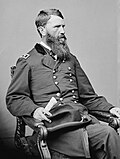 Francis Preston Blair Jr. in military uniform
 -
 Union Army major general rank insignia
 -
 Francis Preston Blair Jr. and staff
 -
 Portrait of Francis Preston Blair Jr.
 -
 Francis Preston Blair Jr.


