Jersey cattle: Difference between revisions
CSV import Tags: mobile edit mobile web edit |
CSV import |
||
| Line 26: | Line 26: | ||
{{Cattle-stub}} | {{Cattle-stub}} | ||
{{food-stub}} | {{food-stub}} | ||
<gallery> | |||
File:Bouëts_d'Jèrri_Êgypte_5_Jèrri_Mai_2009.jpg|Jersey cattle in Egypt, May 2009 | |||
File:Vaques_dé_Jèrri_Octobre_2013_10.jpg|Jersey cattle in October 2013 | |||
File:Jersey_cattle_judging-1.jpg|Jersey cattle judging | |||
File:Jersey_cows_near_Brighstone,_Isle_of_Wight,_England.jpg|Jersey cows near Brighstone, Isle of Wight, England | |||
File:Jersey_cow_sculpture_by_John_McKenna,_St_Helier.JPG|Jersey cow sculpture by John McKenna, St Helier | |||
</gallery> | |||
Latest revision as of 04:57, 18 February 2025
Jersey Cattle is a small breed of dairy cattle. Originally bred in the Channel Island of Jersey, the breed is known for the high butterfat content of its milk and the lower maintenance costs attending its lower bodyweight, as well as its genial disposition.
History[edit]
The Jersey breed originated on the British Channel Island of Jersey. It is believed to have descended from cattle stock brought over from the nearby Norman mainland, and was first recorded as a separate breed around 1700. The breed was isolated from outside influence for over two centuries, from 1789 to 2008, by law intended to maintain the purity of the breed.
Characteristics[edit]
Jersey cattle are smaller than most other breeds, with mature males weighing only 540–820 kg (1,200–1,800 lb) and cows weighing 400–500 kg (880–1,100 lb). They are usually a light brown color, but this can range from a grey to a mulberry. They are renowned for their milk's high butterfat content – around 5% – and high protein levels – around 3.8%. This makes their milk excellent for the production of cheese.
Use[edit]
Jersey cattle are primarily kept for milk production. The high butterfat and protein levels in their milk make it ideal for making cheese, and it is also excellent for butter and cream production. Jerseys are also known for their heat tolerance and ability to adapt to many different management systems.
Health[edit]
Jersey cattle are generally very healthy animals. They are less prone to lameness and mastitis than other dairy breeds. However, they are more susceptible to milk fever, sunburn, and certain metabolic diseases.
Breeding[edit]
Jersey cattle have a high fertility rate, and a shorter gestation period than other dairy breeds. They also have a long productive lifespan, with many cows producing milk for up to 15 years.
See also[edit]

-
 Jersey cattle in Egypt, May 2009
 -
 Jersey cattle in October 2013
 -
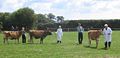 Jersey cattle judging
 -
Jersey cows near Brighstone, Isle of Wight, England
-
Jersey cow sculpture by John McKenna, St Helier


