Membrane transport: Difference between revisions
CSV import |
CSV import |
||
| Line 42: | Line 42: | ||
{{stub}} | {{stub}} | ||
<gallery> | |||
File:Cell_membrane_scheme.png|Cell membrane structure | |||
File:Passive_vs_Active_Membrane_Transport.svg|Passive vs Active Membrane Transport | |||
File:Diffusion.jpg|Diffusion process | |||
File:TransportProteine.png|Transport Protein | |||
File:Sodium_Pump.svg|Sodium Pump | |||
</gallery> | |||
Latest revision as of 04:57, 18 February 2025
Membrane transport refers to the collection of mechanisms that regulate the passage of solutes such as ions and small molecules through biological membranes, which are lipid bilayers that contain proteins embedded in them.
Types of Membrane Transport[edit]
There are two main types of membrane transport, namely Passive Transport and Active Transport.
Passive Transport[edit]
Passive Transport is a method of biomolecule and ion movement across the cell membrane that does not require input of chemical energy. It involves the movement of molecules from an area of higher concentration to an area of lower concentration. This includes simple diffusion, facilitated diffusion, and osmosis.
Simple Diffusion[edit]
Simple Diffusion is a type of passive transport that allows substances to move freely through the lipid bilayer of the plasma membrane of cells without the aid of membrane transport proteins.
Facilitated Diffusion[edit]
Facilitated Diffusion, on the other hand, involves the use of a protein to facilitate the movement of molecules across the membrane. In most cases, it involves the use of a specific channel protein for the molecule to pass through.
Osmosis[edit]
Osmosis is the movement of solvent molecules through a selectively permeable membrane into an area of higher solute concentration, aiming to equalize the solute concentrations on the two sides.
Active Transport[edit]
Active Transport is the movement of ions or molecules across a cell membrane into a region of higher concentration, assisted by enzymes and requiring energy.
See Also[edit]
References[edit]
<references />
 | This medical article is a stub. You can help WikiMD by expanding the page. |
-
 Cell membrane structure
 -
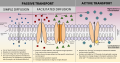 Passive vs Active Membrane Transport
 -
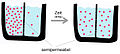 Diffusion process
 -
 Transport Protein
 -
 Sodium Pump


