Medullary pyramids (brainstem): Difference between revisions
CSV import Tags: mobile edit mobile web edit |
CSV import Tags: mobile edit mobile web edit |
||
| Line 28: | Line 28: | ||
{{Neuroanatomy-stub}} | {{Neuroanatomy-stub}} | ||
{{Medicine-stub}} | {{Medicine-stub}} | ||
<gallery> | |||
File:Medulla_oblongata,_pons_and_middle_cerebellar_peduncle2.jpg|Medulla oblongata, pons, and middle cerebellar peduncle | |||
File:Pyramid_(medulla_oblongata)_-_animation.gif|Animation of the pyramid in the medulla oblongata | |||
File:Gray679.png|Medullary pyramids (brainstem) | |||
File:Gray684.png|Medullary pyramids (brainstem) | |||
File:Gray688.png|Medullary pyramids (brainstem) | |||
</gallery> | |||
Latest revision as of 04:56, 18 February 2025
Medullary Pyramids (Brainstem)
The Medullary Pyramids are two elongated ridges on the anterior surface of the medulla oblongata, a part of the brainstem. They are also known as the anterior medullary velum and are a key component of the central nervous system (CNS).
Anatomy[edit]
The Medullary Pyramids are located on the ventral aspect of the medulla oblongata, the lower half of the brainstem. They are situated beside the anterior median fissure, and are flanked by the olives. Each pyramid contains approximately one million corticospinal and corticobulbar fibers, which are essential for the voluntary control of the musculoskeletal system.
Function[edit]
The primary function of the Medullary Pyramids is to house the pyramidal tracts – the upper motor neuronal axons which originate in the cerebral cortex and terminate in the spinal cord or brainstem. These tracts are responsible for the voluntary control of the musculoskeletal system. The pyramidal tracts descend in the pyramids and most of them cross to the opposite side at the junction between the medulla and the spinal cord, in a process known as decussation.
Clinical Significance[edit]
Damage to the Medullary Pyramids can result in a range of motor disorders, including paralysis and spasticity. This is due to the disruption of the pyramidal tracts, which play a crucial role in motor control. Conditions such as Amyotrophic lateral sclerosis (ALS) and Multiple sclerosis (MS) can affect the Medullary Pyramids.
See Also[edit]
This article is a neuroanatomy stub. You can help WikiMD by expanding it!

-
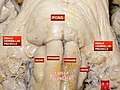 Medulla oblongata, pons, and middle cerebellar peduncle
 -
 Animation of the pyramid in the medulla oblongata
 -
Medullary pyramids (brainstem)
-
Medullary pyramids (brainstem)
-
Medullary pyramids (brainstem)

_-_animation.gif)


