Kessler syndrome: Difference between revisions
CSV import Tags: mobile edit mobile web edit |
CSV import |
||
| Line 26: | Line 26: | ||
[[Category:Orbital mechanics]] | [[Category:Orbital mechanics]] | ||
{{space-stub}} | {{space-stub}} | ||
== Kessler_syndrome == | |||
<gallery> | |||
File:Debris-GEO1280.jpg|Space debris in geostationary orbit | |||
File:Gabbard_diagram.png|Gabbard diagram illustrating debris distribution | |||
File:Baker-Nunn_camera.jpg|Baker-Nunn camera used for tracking space debris | |||
File:Space_Debris_Low_Earth_Orbit.png|Space debris in low Earth orbit | |||
</gallery> | |||
Latest revision as of 04:55, 18 February 2025
Kessler Syndrome is a scenario in which the density of objects in Low Earth Orbit (LEO) is high enough that collisions between objects could cause a cascade—each collision generating space debris that increases the likelihood of further collisions. This concept was proposed by the NASA scientist Donald J. Kessler in 1978, along with Burton Cour-Palais. The syndrome is also known as the Kessler effect, collisional cascading, or ablation cascade.
Overview[edit]
The Kessler Syndrome describes a self-sustaining cascading collision of space debris in Earth's orbit. As the number of artificial satellites in Earth's orbit increases, the probability of collisions also rises, especially in densely populated orbits. A single collision can generate thousands of smaller debris fragments, each capable of causing further collisions and debris. This chain reaction can potentially render orbits around Earth unusable for generations due to the risk of collision with debris.
Causes[edit]
The primary cause of the Kessler Syndrome is the high volume of space debris in LEO, which includes defunct satellites, spent rocket stages, and fragments from previous collisions or explosions. Factors contributing to the risk include the proliferation of satellites due to the reduced cost of satellite launches, military activities that may intentionally create debris, and natural collisions with meteoroids.
Consequences[edit]
The implications of the Kessler Syndrome are significant for space operations. It could lead to the loss of critical satellites that provide essential services such as communication, weather forecasting, and Earth observation. Additionally, it poses a risk to human spaceflight missions, including those to the International Space Station (ISS), and could hinder future space exploration efforts.
Mitigation and Management[edit]
Efforts to mitigate the Kessler Syndrome focus on debris removal, collision avoidance, and the design of satellites for end-of-life disposal. Projects and concepts for debris removal include nets, harpoons, and lasers to either de-orbit debris or move it to safer orbits. Collision avoidance involves tracking debris and maneuvering satellites to prevent collisions. Designing satellites for end-of-life disposal includes measures such as de-orbiting mechanisms or moving satellites to a "graveyard orbit."
In Popular Culture[edit]
The Kessler Syndrome has been featured in various works of fiction, including films, novels, and video games, often depicted as a catastrophic event leading to Earth's isolation from space.
See Also[edit]

This article is a space- or spaceflight-related stub. You can help WikiMD by expanding it!
Kessler_syndrome[edit]
-
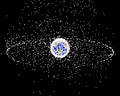 Space debris in geostationary orbit
 -
 Gabbard diagram illustrating debris distribution
 -
 Baker-Nunn camera used for tracking space debris
 -
 Space debris in low Earth orbit


