Gnetum africanum: Difference between revisions
CSV import |
CSV import |
||
| Line 23: | Line 23: | ||
{{food-stub}} | {{food-stub}} | ||
{{plant-stub}} | {{plant-stub}} | ||
<gallery> | |||
File:Mfumbwa_-_Gnetum_africanum,_leaves_bundle_and_chopped.jpg|Gnetum africanum leaves bundle and chopped | |||
File:Ikok_mixé_et_son_manioc_vapeur.jpg|Ikok mixé et son manioc vapeur | |||
File:Exposition_vente_des_femmes17.jpg|Exposition vente des femmes | |||
File:Water_fufu_and_eru_03.jpg|Water fufu and eru | |||
</gallery> | |||
Latest revision as of 04:54, 18 February 2025
Gnetum africanum is a tropical evergreen vine native to Africa and Asia. It is part of the Gnetaceae family and is commonly known as Afang in Nigeria and Eru in Cameroon. The plant is a source of food and traditional medicines in its native regions.
Description[edit]
Gnetum africanum is a climbing vine that can grow up to 40 feet in length. The leaves are dark green, glossy, and oval in shape. The plant produces small, yellow flowers and a fruit that is red when ripe.
Cultivation[edit]
Gnetum africanum is a tropical plant and requires a warm, humid environment to thrive. It is typically grown in rainforests or in shaded areas near rivers and streams. The plant is propagated through seeds or cuttings.
Uses[edit]
The leaves of Gnetum africanum are used in the preparation of a popular soup known as Afang soup in Nigeria and Eru soup in Cameroon. The leaves are also used in traditional medicine to treat various ailments such as malaria, hypertension, and infertility.
Conservation[edit]
Gnetum africanum is currently listed as an endangered species by the International Union for Conservation of Nature (IUCN). The main threats to the species are deforestation and over-harvesting for food and medicine.
See also[edit]


-
 Gnetum africanum leaves bundle and chopped
 -
 Ikok mixé et son manioc vapeur
 -
 Exposition vente des femmes
 -
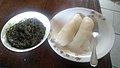 Water fufu and eru


