Swaim's Panacea: Difference between revisions
CSV import |
CSV import |
||
| Line 18: | Line 18: | ||
{{pharma-stub}} | {{pharma-stub}} | ||
== Swaim's Panacea == | |||
<gallery> | |||
File:Swaims_Panacea.tif|Swaim's Panacea | |||
File:Nancy_Linton.jpg|Nancy Linton | |||
File:Swaims_Panacea_1822.png|Swaim's Panacea 1822 | |||
File:Swaims_Panacea_1890.png|Swaim's Panacea 1890 | |||
File:Swaims_Panacea_1895.png|Swaim's Panacea 1895 | |||
</gallery> | |||
Latest revision as of 04:54, 18 February 2025
Swaim's Panacea was a patent medicine widely marketed in the United States during the 19th century. It exemplifies the era's medical practices and the public's trust in advertised remedies, despite the often dubious efficacy and safety of such products. Swaim's Panacea was claimed to cure a wide range of diseases, reflecting the common practice of the time to market medicines as cure-alls.
History[edit]
Swaim's Panacea was created by William Swaim in Philadelphia around 1820. The medicine gained popularity quickly, thanks to aggressive advertising in newspapers and pamphlets, which was a common strategy for patent medicines. Swaim's marketing boasted of miraculous cures, claiming the panacea could treat conditions ranging from scrofula, syphilis, and mercurial diseases to more common ailments like rheumatism and dyspepsia.
Composition[edit]
The exact formula of Swaim's Panacea is not fully documented, but it was known to contain sarsaparilla, a common ingredient in patent medicines of the time, believed to have purifying properties. Other components likely included herbs and possibly substances like mercury and alcohol, which were common in medicines of that era but are now known to be harmful or ineffective for many of the conditions they were supposed to treat.
Impact and Controversy[edit]
Swaim's Panacea is a notable example of the broader phenomenon of patent medicines, which were often sold with exaggerated claims and without proper evidence of their efficacy. The popularity of such remedies highlights the limited medical knowledge and regulatory oversight of the time, allowing potentially dangerous concoctions to be sold freely. The controversy surrounding patent medicines like Swaim's Panacea eventually contributed to the push for better regulation of drugs in the United States, leading to the enactment of the Pure Food and Drug Act in 1906.
Legacy[edit]
Today, Swaim's Panacea is remembered more for its role in the history of medicine and advertising than for any therapeutic value. It serves as a cautionary tale about the importance of skepticism towards medical claims and the need for regulation to protect consumers from potentially harmful products. The story of Swaim's Panacea and similar products also provides insight into the social and cultural history of the 19th century, reflecting the hopes, fears, and beliefs of the people who bought and used these medicines.

Swaim's Panacea[edit]
-
 Swaim's Panacea
 -
 Nancy Linton
 -
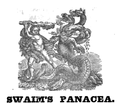 Swaim's Panacea 1822
 -
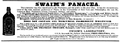 Swaim's Panacea 1890
 -
 Swaim's Panacea 1895


