Magnetic confinement fusion: Difference between revisions
CSV import |
CSV import |
||
| Line 33: | Line 33: | ||
[[Category:Magnetic confinement fusion]] | [[Category:Magnetic confinement fusion]] | ||
{{physics-stub}} | {{physics-stub}} | ||
<gallery> | |||
File:MAST_plasma_image.jpg|MAST plasma image | |||
File:U.S._Department_of_Energy_-_Science_-_528_002_001_(9788861274).jpg|U.S. Department of Energy - Science | |||
File:Tokamak_fields_lg.png|Tokamak magnetic fields | |||
File:A_SPARC_of_Fusion_Energy_(50402096131).jpg|A SPARC of Fusion Energy | |||
</gallery> | |||
Latest revision as of 04:48, 18 February 2025
Magnetic confinement fusion is a method of achieving nuclear fusion by using magnetic fields to confine the hot fusion fuel in the form of a plasma. Magnetic confinement is one of two major branches of fusion energy research, the other being inertial confinement fusion. The magnetic approach is more developed and is considered more likely to be practical for energy production.
Principle[edit]
The basic concept behind magnetic confinement fusion is the use of magnetic fields to confine the plasma. Since the fuel must be heated to temperatures of millions of degrees to induce fusion reactions, it cannot be contained by any physical material. Instead, the confinement is achieved by the Lorentz force, a force experienced by charged particles in a magnetic field.
Types of Magnetic Confinement[edit]
There are several types of magnetic confinement systems, the most well-known being the tokamak and the stellarator. Other types include the reversed field pinch, the spheromak, the Field-Reversed Configuration, and the Levitated Dipole.
Tokamak[edit]
The tokamak is the most developed and best-studied type of magnetic confinement system. It uses a combination of two sets of magnetic fields: one created by external coils, and a second created by a current flowing in the plasma itself. The tokamak configuration is toroidal, or doughnut-shaped.
Stellarator[edit]
The stellarator is similar to the tokamak, but it does not require a current flowing in the plasma. Instead, it uses a more complex set of external coils to create the confining magnetic field. The stellarator configuration can be toroidal or helical.
Challenges[edit]
Despite the progress made in magnetic confinement fusion research, there are still many challenges to be overcome. These include maintaining the stability of the plasma, dealing with the high heat fluxes at the plasma edge, and finding materials that can withstand the harsh conditions inside the fusion reactor.
See also[edit]

-
 MAST plasma image
 -
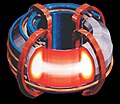 U.S. Department of Energy - Science
 -
 Tokamak magnetic fields
 -
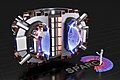 A SPARC of Fusion Energy

.jpg)

.jpg)
