Dust mite allergy: Difference between revisions
CSV import Tags: mobile edit mobile web edit |
CSV import Tags: mobile edit mobile web edit |
||
| Line 61: | Line 61: | ||
{{Medicine-stub}} | {{Medicine-stub}} | ||
== Dust_mite_allergy == | |||
<gallery> | |||
File:CSIRO_ScienceImage_11085_A_scanning_electron_micrograph_of_a_female_dust_mite.jpg|A scanning electron micrograph of a female dust mite | |||
File:House_dust_mites_(5247397771).jpg|House dust mites | |||
File:House_dust_mites_(5247996458).jpg|House dust mites | |||
</gallery> | |||
Revision as of 04:44, 18 February 2025
Dust Mite Allergy' is a common condition caused by an allergic reaction to dust mites, microscopic organisms that thrive in household dust. People with this allergy have symptoms that can range from mild to severe and are often similar to those of hay fever or asthma.
Causes
Dust mite allergies are triggered by proteins found in the feces and decaying bodies of dust mites. These proteins can cause the immune system of an allergic person to overreact, leading to inflammation in the nasal passages or lungs.
Symptoms
Common symptoms of a dust mite allergy include:
- Sneezing
- Runny or stuffy nose
- Itchy, red, or watery eyes
- Postnasal drip
- Cough
- Facial pressure and pain
- Frequent awakening
- Swollen, blue-colored skin under the eyes
- In a child, frequent upward rubbing of the nose
If a dust mite allergy contributes to asthma, one may also experience:
- Difficulty breathing
- Chest tightness or pain
- An audible whistling or wheezing sound when exhaling
- Trouble sleeping caused by shortness of breath, coughing, or wheezing
Diagnosis
Diagnosis of a dust mite allergy typically involves a medical history and physical exam. A doctor may also recommend one or more tests to confirm the allergy:
- Skin prick test: A small amount of the allergen is placed on the skin, which is then pricked to allow the allergen to enter underneath. A reaction indicates an allergy.
- Allergen-specific IgE antibody test: This blood test measures the immune system's response to dust mites by measuring the amount of certain antibodies in the bloodstream.
Treatment
Treatment for a dust mite allergy can include a combination of medications and lifestyle changes to reduce symptoms. Medications may include:
- Nasal corticosteroids
- Antihistamines
- Decongestants
- Leukotriene modifiers
- Nasal irrigation
Lifestyle changes and home remedies that can help manage symptoms include:
- Using allergen-proof bed covers
- Washing bedding in hot water weekly
- Keeping humidity low
- Removing carpeting from bedrooms
- Using a high-efficiency particulate air (HEPA) filter in the bedroom
Prevention
Preventive measures to reduce exposure to dust mites include:
- Encasing mattresses, box springs, and pillows in allergen-proof covers
- Washing all bedding in hot water at least once a week
- Maintaining low indoor humidity
- Removing dust-collecting clutter from the home
- Vacuuming regularly with a vacuum equipped with a HEPA filter
See Also
 | This medical article is a stub. You can help Wikipedia by adding missing information. |
Dust_mite_allergy
-
 A scanning electron micrograph of a female dust mite
 -
 House dust mites
 -
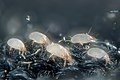 House dust mites

.jpg)
.jpg)
