XO sauce: Difference between revisions
CSV import |
CSV import |
||
| Line 26: | Line 26: | ||
{{Chinese-food-stub}} | {{Chinese-food-stub}} | ||
{{food-stub}} | {{food-stub}} | ||
<gallery> | |||
File:Rice_with_XO_sauce.jpg|Rice with XO sauce | |||
File:XO_sauce.jpg|XO sauce | |||
File:XO_Sauce_Packaging_&_Bottle.JPG|XO Sauce Packaging & Bottle | |||
File:XO_eggs_at_Valley_Bar_+_Bottle_Shop_-_August_2022_-_Sarah_Stierch_02.jpg|XO eggs at Valley Bar & Bottle Shop | |||
</gallery> | |||
Latest revision as of 04:39, 18 February 2025
XO sauce is a spicy seafood sauce that originated from Hong Kong. It is commonly used in Cantonese cuisine and is known for its savory and slightly spicy flavor. The name "XO" stands for "extra-old", which is a term borrowed from the cognac grading system to signify high quality.
History[edit]
XO sauce was developed in the 1980s in Hong Kong. It was created by luxury hotels and high-end restaurants to demonstrate the high quality of their dishes. The sauce quickly gained popularity and is now a staple in many Cantonese dishes.
Ingredients[edit]
The primary ingredients of XO sauce are dried scallop, dried shrimp, Jinhua ham, red chili pepper, garlic, and canola oil. Some variations may also include dried fish and other seafood. The ingredients are finely chopped, then slowly cooked in oil until they reach a jam-like consistency.
Uses[edit]
XO sauce is used as a condiment for seafood, meats, vegetables, and tofu. It can also be used in cooking to enhance the flavor of dishes such as fried rice, noodles, and stir-fry. In addition, it is often served as a dipping sauce for dim sum.
Commercial Availability[edit]
While XO sauce can be made at home, it is also commercially available. Many Asian grocery stores and online retailers sell pre-made XO sauce. The price can vary significantly depending on the quality of the ingredients used.
See Also[edit]

-
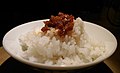 Rice with XO sauce
 -
XO sauce
-
XO Sauce Packaging & Bottle
-
XO eggs at Valley Bar & Bottle Shop


