Vitis rupestris: Difference between revisions
CSV import |
CSV import |
||
| Line 33: | Line 33: | ||
{{Grape-stub}} | {{Grape-stub}} | ||
{{food-stub}} | {{food-stub}} | ||
<gallery> | |||
File:Vitis_rupestris_Weinsberg_20071016.jpg|Vitis rupestris in Weinsberg | |||
File:Vitis_rupestris_leaves.jpg|Leaves of Vitis rupestris | |||
File:Vitis_rupestris.jpg|Vitis rupestris | |||
File:Photograph_of_Vitis_rupestris_from_the_book_The_Grapes_of_New_York_1908.jpg|Photograph of Vitis rupestris from "The Grapes of New York" (1908) | |||
</gallery> | |||
Latest revision as of 04:36, 18 February 2025
Vitis rupestris is a species of grapevine native to the United States. It is a member of the Vitis genus, which includes all species of grapevines. Vitis rupestris is known for its resistance to Phylloxera, a pest that can devastate many other species of grapevines.
Description[edit]
Vitis rupestris is a deciduous vine that can grow up to 3 meters in height. The leaves are simple, alternate, and typically heart-shaped. The flowers are small and greenish, and the fruit is a small, black grape. The vine is known for its deep, extensive root system, which allows it to survive in a variety of soil conditions.
Distribution and Habitat[edit]
Vitis rupestris is native to the central United States, from Texas to South Dakota and east to the Atlantic Ocean. It is typically found in rocky or sandy soils along riverbanks and streams.
Uses[edit]
Vitis rupestris is primarily used in grape breeding programs for its resistance to Phylloxera. It is often used as a rootstock, onto which other grapevine species are grafted. This allows the grafted vine to benefit from the rootstock's resistance to pests and diseases, as well as its ability to tolerate various soil conditions.
Cultivation[edit]
Cultivation of Vitis rupestris requires a sunny location and well-drained soil. The vine is drought-tolerant and can survive in poor soil conditions. However, it does not tolerate wet or poorly drained soils.
Research[edit]
Research into Vitis rupestris has focused on its resistance to Phylloxera and its potential use in grape breeding programs. Studies have also investigated the vine's root system and its ability to tolerate various soil conditions.
See Also[edit]
| Vitis | ||||||||
|---|---|---|---|---|---|---|---|---|
This Vitis-related article is a stub.
|

This article is a wine grape–related stub. You can help WikiMD by expanding it!

-
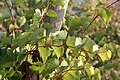 Vitis rupestris in Weinsberg
 -
 Leaves of Vitis rupestris
 -
 Vitis rupestris
 -
 Photograph of Vitis rupestris from "The Grapes of New York" (1908)


