Potassium iodide: Difference between revisions
CSV import Tags: mobile edit mobile web edit |
CSV import |
||
| Line 19: | Line 19: | ||
{{Chemistry-stub}} | {{Chemistry-stub}} | ||
{{Medicine-stub}} | {{Medicine-stub}} | ||
== Potassium_iodide == | |||
<gallery> | |||
File:Potassium_iodide.jpg|Potassium iodide | |||
File:Potassium-iodide-3D-ionic.png|3D ionic structure of potassium iodide | |||
File:Pheochromocytoma_Scan.jpg|Pheochromocytoma scan | |||
File:Sandmeyer_reaction.svg|Sandmeyer reaction | |||
File:Distributiegebieden-jodiumtabletten.png|Distribution areas of iodine tablets | |||
</gallery> | |||
Latest revision as of 04:36, 18 February 2025
Potassium Iodide is a chemical compound with the formula KI. This white salt is the most commercially significant iodide compound, with approximately 37,000 tons produced in 1985. It is less hygroscopic (absorbs water less readily) than sodium iodide, making it easier to work with.
Chemical Properties[edit]
Potassium iodide is an ionic compound which is made of the following ions: Potassium (K+) and Iodide (I-). It is a white, crystalline solid that has a similar appearance to table salt. It is stable in air and reacts with strong oxidants such as chlorine and bromine.
Uses[edit]
Potassium iodide is often used as a nutritional supplement in animal feeds. It is also used medicinally in tablets, usually for thyroid conditions. It is a common additive to table salt to prevent iodine deficiency. In photography, KI is used as a component in film development.
Health Effects[edit]
Potassium iodide can be harmful if ingested in large amounts. It can cause thyroid problems, high potassium levels in the blood, or iodide poisoning. However, it is generally safe to use as directed by a healthcare provider.
See Also[edit]


Potassium_iodide[edit]
-
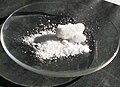 Potassium iodide
 -
 3D ionic structure of potassium iodide
 -
 Pheochromocytoma scan
 -
 Sandmeyer reaction
 -
 Distribution areas of iodine tablets


