Coccidioides immitis: Difference between revisions
CSV import |
CSV import Tags: mobile edit mobile web edit |
||
| Line 24: | Line 24: | ||
{{Fungi-stub}} | {{Fungi-stub}} | ||
{{Medicine-stub}} | {{Medicine-stub}} | ||
<gallery> | |||
File:Coccidioides_immitis.jpg|Coccidioides immitis | |||
File:Coccidioides_immitis_on_Sabouraud's_medium.jpg|Coccidioides immitis on Sabouraud's medium | |||
File:Coccidioides_immitis_microscopy.jpg|Coccidioides immitis microscopy | |||
File:Arthroconidia_of_Coccidioides_immitis_39G0040_lores.jpg|Arthroconidia of Coccidioides immitis | |||
</gallery> | |||
Latest revision as of 04:36, 18 February 2025
Coccidioides immitis is a pathogenic fungus that resides in the soil of certain parts of the United States, particularly in the southwestern region. It is the causative agent of Coccidioidomycosis, also known as Valley Fever, a disease that primarily affects the lungs and can be severe, especially in immunocompromised individuals.
Taxonomy[edit]
Coccidioides immitis belongs to the kingdom Fungi, phylum Ascomycota, class Eurotiomycetes, order Onygenales, family Onygenaceae, and genus Coccidioides. It is one of the two species in the genus Coccidioides, the other being Coccidioides posadasii.
Morphology[edit]
Coccidioides immitis exists in two forms: a mycelial form and a spherule form. The mycelial form is found in the environment and produces infectious arthroconidia. When these arthroconidia are inhaled by a susceptible host, they transform into the spherule form in the host's body.
Pathogenesis[edit]
The disease caused by Coccidioides immitis, Coccidioidomycosis, is typically acquired through inhalation of airborne, microscopic, fungal particles known as arthroconidia. These particles are released into the air when the soil is disturbed. Once inhaled, the arthroconidia transform into spherules, which are larger structures that contain endospores. When the spherules mature, they rupture and release the endospores, which can develop into new spherules and continue the cycle of infection.
Diagnosis and Treatment[edit]
Diagnosis of Coccidioidomycosis is typically made through clinical presentation, history of exposure to endemic areas, and laboratory testing. The most common tests are serological tests that detect antibodies against Coccidioides immitis. Treatment usually involves antifungal medications, such as fluconazole and itraconazole.
Epidemiology[edit]
Coccidioides immitis is endemic to the southwestern United States, particularly in parts of Arizona, California, Nevada, New Mexico, Texas, and Utah. It is also found in parts of Mexico and Central and South America. The disease is more common in people who live or work in these areas, especially those who are involved in activities that disturb the soil.
Prevention[edit]
Prevention of Coccidioidomycosis primarily involves avoiding activities that disturb the soil in endemic areas. When such activities cannot be avoided, wearing a mask can help reduce the risk of inhalation of the fungal particles.


-
 Coccidioides immitis
 -
 Coccidioides immitis on Sabouraud's medium
 -
 Coccidioides immitis microscopy
 -
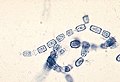 Arthroconidia of Coccidioides immitis


