Common wheat: Difference between revisions
CSV import |
CSV import |
||
| Line 30: | Line 30: | ||
[[Category:Poales]] | [[Category:Poales]] | ||
{{dictionary-stub1}} | {{dictionary-stub1}} | ||
<gallery> | |||
File:Blé_tendre_(GRAPELLI)_AO-5-cliche_Jean_Weber_(5)_(23975019962).jpg|Common wheat | |||
File:Triticum_aestivum_subsp._aestivum_MHNT.BOT.2015.2.31.jpg|Common wheat | |||
File:A_field_of_wheat.JPG|A field of wheat | |||
File:usdacompactum.jpg|Common wheat | |||
</gallery> | |||
Revision as of 04:35, 18 February 2025
Common wheat (Triticum aestivum), also known as bread wheat, is a cultivated wheat species.<ref>{{{last}}},
 Bonjean, Alain P. and William J. Angus (eds),

 The world wheat book : a history of wheat breeding,

 Andover:Intercept,
 2001,


 ISBN 1-898298-72-6, Excellent resource for 20th century plant breeding.</ref><ref>{{{last}}},
 Caligari, P.D.S. and P.E. Brandham (eds),

 Wheat taxonomy : the legacy of John Percival,

 London:Linnean Society, Linnean Special Issue 3,
 2001,</ref><ref>{{{last}}},
 Heyne E.G. (ed.),

 Wheat and wheat improvement,

 Madison, Wis.:American Society of Agronomy,
 1987,


 ISBN 0-89118-091-5,</ref><ref name=Zohary>{{{last}}},
 Zohary, Daniel and Maria Hopf,

 Domestication of Old World plants: the origin and spread of cultivated plants in West Asia,

 Oxford:Oxford University Press,
 2000,


 ISBN 0-19-850356-3, Standard reference for evolution and early history.</ref> About 95% of the wheat produced is common wheat.
Common wheat has been got by many generations of artificial selection by farmers choosing the most productive plants which occurred in their crops.<ref name=Zohary/>
Evolution
Bread wheat is an allohexaploid, instead of the original two sets (diploid). There are six sets of chromosomes, two sets from each of three different species.<ref>Brenchley et al 2012. Analysis of the bread wheat genome using whole-genome shotgun sequencing. Nature 491 (7426): 705–10. [1]</ref><ref name=Mayer>Mayer K.F.X. 2014. A chromosome-based draft sequence of the hexaploid bread wheat (Triticum aestivum) genome. Science 345 (6194): [2]</ref>. Free-threshing wheat is closely related to spelt wheat. As with spelt, genes from goatgrass (Aegilops tauschii) give bread wheat greater cold hardiness than most wheats. It is cultivated throughout the world's temperate zones.
Of the six sets of chromosomes, two come from einkorn wheat and two from Aegilops speltoides. This hybridisation created the species Triticum turgidum, 580– 820 thousand years ago. The last two sets of chromosomes came from Aegilops tauschii, 230–430 thousand years ago.<ref>Marcussen T. et al 2014. Ancient hybridizations among the ancestral genomes of bread wheat. Science 345 (6194): [3].</ref>
References

-
 Common wheat
 -
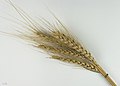 Common wheat
 -
 A field of wheat
 -
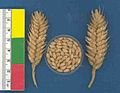 Common wheat
_AO-5-cliche_Jean_Weber_(5)_(23975019962).jpg)


