Lead(II) chloride: Difference between revisions
CSV import |
CSV import |
||
| Line 20: | Line 20: | ||
[[Category:Chlorides]] | [[Category:Chlorides]] | ||
{{Chem-stub}} | {{Chem-stub}} | ||
<gallery> | |||
File:Cotunnite-3D-balls.png|Lead(II) chloride | |||
File:Cotunnite-3D-ionic.png|Lead(II) chloride | |||
File:Cotunnite-Pb-coordination-geometry-3D-balls.png|Lead(II) chloride | |||
File:Cotunnite-Cl-coordination-geometry-3D-balls.png|Lead(II) chloride | |||
File:Cotunnite-Pb-coordination-CM-3D-balls.png|Lead(II) chloride | |||
</gallery> | |||
Latest revision as of 04:34, 18 February 2025
_chloride.jpg)
Lead(II) chloride, also known as plumbous chloride, is a chemical compound with the formula PbCl2. It is a white solid under ambient conditions, although it tends to become off-white or greyish with exposure to air due to the presence of impurities. Lead(II) chloride is poorly soluble in water, a property that is exploited in some of its applications.
Properties[edit]
Lead(II) chloride is an inorganic compound that crystallizes in an orthorhombic lattice structure. It has a melting point of 501 °C and boils at 954 °C. In water, its solubility is relatively low, but it increases significantly in the presence of chloride ions, due to the formation of complex ions such as [PbCl3]− and [PbCl4]2−.
Synthesis[edit]
Lead(II) chloride can be prepared by reacting lead(II) nitrate with sodium chloride:
- Pb(NO3)2 + 2NaCl → PbCl2 + 2NaNO3
This reaction is typically performed in an aqueous solution, where lead(II) chloride precipitates out due to its low solubility.
Applications[edit]
Lead(II) chloride is used in a variety of applications, including:
- As a precursor in the synthesis of lead(IV) chloride (PbCl4), which is used in organic synthesis.
- In the production of infrared transmitting glass, as lead(II) chloride has specific properties that allow it to pass infrared light while blocking visible light.
- As a source of lead ions in analytical chemistry, particularly in the detection of certain anions.
Safety[edit]
Lead(II) chloride is toxic, primarily due to its lead content. Exposure to lead compounds can cause serious health issues, including neurological damage and kidney failure. Handling of lead(II) chloride should be done with appropriate safety measures, including the use of personal protective equipment and working in a well-ventilated area.
Environmental Impact[edit]
The environmental impact of lead(II) chloride is significant, as lead compounds are persistent pollutants. They can accumulate in the environment and in the tissues of living organisms, leading to lead poisoning in wildlife and humans. Efforts to minimize the use and release of lead compounds into the environment are important for protecting public health and ecosystems.

-
 Lead(II) chloride
 -
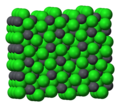 Lead(II) chloride
 -
 Lead(II) chloride
 -
 Lead(II) chloride
 -
 Lead(II) chloride


