Yomari: Difference between revisions
CSV import Tags: mobile edit mobile web edit |
CSV import |
||
| Line 23: | Line 23: | ||
{{Nepal-cuisine-stub}} | {{Nepal-cuisine-stub}} | ||
{{food-stub}} | {{food-stub}} | ||
<gallery> | |||
File:Yomari_4.jpg|Yomari | |||
File:Yomari_Punhi.jpg|Yomari Punhi | |||
File:Yamari.jpg|Yomari | |||
File:Yomari_Inside.jpg|Yomari Inside | |||
File:Yomari.jpg|Yomari | |||
</gallery> | |||
Latest revision as of 04:29, 18 February 2025
Yomari is a traditional sweet dish from the Newar community of Nepal. It is a steamed dumpling that takes the shape of a fish and is made from rice flour, with a filling of molasses and sesame seeds. Yomari is particularly popular during the post-harvest celebration of Yomari Punhi, which marks the end of the rice harvest.
Etymology[edit]
The term "Yomari" comes from two Newari words, "ya:" meaning "to love" and "mari" meaning "bread". Thus, Yomari can be translated as "loved bread".
Preparation[edit]
The preparation of Yomari involves making a dough from rice flour and water. This dough is then shaped into a figure-eight or a fish, which is symbolic in the Newar culture. The cavity of the dough is filled with a mixture of molasses and sesame seeds. The Yomari is then steamed until it is cooked.
Cultural Significance[edit]
Yomari holds a significant place in Newar culture. It is a staple food during the Yomari Punhi festival, which is celebrated on the full moon day of the month of Mangsir in the Vikram Samvat calendar. During this festival, people make Yomari and offer them to the goddess Annapurna, the Hindu goddess of food and nourishment, for a prosperous year ahead. The festival also marks the end of the rice harvest season.
Variations[edit]
There are several variations of Yomari. Some of these include Chaku Yomari, which is filled with a sweet substance called Chaku, and Khuwa Yomari, which is filled with a sweet dairy product called Khuwa.
See Also[edit]

This article is a Nepalese cuisine–related stub. You can help WikiMD by expanding it!

-
 Yomari
 -
 Yomari Punhi
 -
 Yomari
 -
 Yomari Inside
 -
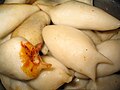 Yomari


