Brodmann area 33: Difference between revisions
CSV import |
CSV import |
||
| Line 30: | Line 30: | ||
{{Neuroscience-stub}} | {{Neuroscience-stub}} | ||
<gallery> | <gallery> | ||
File:Brodmann_area_33_animation_small.gif|Brodmann area 33 animation | |||
File:Brodmann_area_33_medial.jpg|Brodmann area 33 medial view | |||
</gallery> | |||
<gallery> | |||
File:Brodmann_Cytoarchitectonics_33.png|Brodmann area 33 cytoarchitectonics | |||
File:Gray727-Brodman.png|Brodmann areas in the human brain | |||
File:Brodmann_area_33_animation_small.gif|Brodmann area 33 animation | File:Brodmann_area_33_animation_small.gif|Brodmann area 33 animation | ||
File:Brodmann_area_33_medial.jpg|Brodmann area 33 medial view | File:Brodmann_area_33_medial.jpg|Brodmann area 33 medial view | ||
</gallery> | </gallery> | ||
Revision as of 04:28, 18 February 2025
Brodmann area 33 (BA33), also known as the pre-cingulate area, is a region of the cerebral cortex located in the medial frontal lobe of the brain. It is part of the cingulate cortex and is situated anterior to the area 24. This area is involved in various cognitive and emotional processes, including pain processing, emotion regulation, and autonomic function.
Anatomy
Brodmann area 33 is defined based on its cytoarchitecture rather than its exact anatomical boundaries, which can vary between individuals. It is located in the cingulate gyrus, specifically in the anterior portion of the cingulate, adjacent to the corpus callosum. This area is characterized by a distinct layer IV, which is not as prominent in other parts of the cingulate cortex.
Function
The precise functions of BA33 are still under investigation, but it is known to play a role in integrating sensory information with emotional responses. It is involved in the processing of pain and is thought to modulate the emotional aspects of pain perception. Additionally, BA33 has been implicated in autonomic nervous system regulation, influencing heart rate and blood pressure.
BA33 also plays a role in social cognition, including the perception of social exclusion and the processing of empathy. This suggests its involvement in complex emotional and social behaviors.
Clinical Significance
Alterations in the activity or structure of Brodmann area 33 have been associated with various neuropsychiatric disorders, including depression, anxiety disorders, and schizophrenia. It is thought that dysregulation of this area may contribute to the emotional and cognitive symptoms observed in these conditions.
Furthermore, because of its role in pain perception, BA33 is a target for research into chronic pain conditions and the development of interventions that may modulate its activity to provide relief.
Research
Ongoing research aims to further elucidate the specific functions of Brodmann area 33, its connections with other brain regions, and its involvement in various neurological and psychiatric conditions. Advanced imaging techniques, such as functional magnetic resonance imaging (fMRI) and positron emission tomography (PET), are commonly used to study this area in both healthy and clinical populations.
See Also
References
<references/>

This article is a neuroscience stub. You can help WikiMD by expanding it!
-
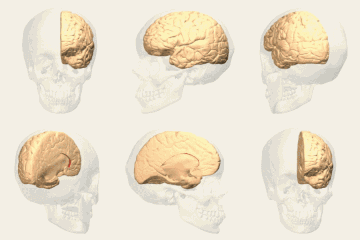 Brodmann area 33 animation
 -
 Brodmann area 33 medial view


-
 Brodmann area 33 cytoarchitectonics
 -
 Brodmann areas in the human brain
 -
Brodmann area 33 animation
-
Brodmann area 33 medial view


