Venous return: Difference between revisions
CSV import |
CSV import |
||
| Line 41: | Line 41: | ||
[[Category:Cardiovascular physiology]] | [[Category:Cardiovascular physiology]] | ||
<gallery> | |||
File:Starling_RAP_combined.svg|Starling's Law of the Heart and Right Atrial Pressure | |||
File:Vascular_function_curve.png|Vascular Function Curve | |||
File:Cardiac_and_vascular_function_curves.png|Cardiac and Vascular Function Curves | |||
File:Venous_return_curves.png|Venous Return Curves | |||
</gallery> | |||
Revision as of 04:26, 18 February 2025
The physiological process of blood returning to the heart
Venous return is the rate of blood flow back to the heart. It is a crucial component of the cardiovascular system, as it influences the cardiac output and overall circulatory function. Venous return is affected by several factors, including the venous pressure, the venous compliance, and the right atrial pressure.
Physiology
Venous return is primarily driven by the pressure gradient between the systemic circulation and the right atrium of the heart. The pressure in the systemic veins is higher than in the right atrium, allowing blood to flow back to the heart. This process is facilitated by the venous valves, which prevent backflow, and the muscle pump, which aids in propelling blood through the veins during physical activity.
Factors affecting venous return
Several factors can influence venous return:
- Venous pressure: The pressure within the veins is a major determinant of venous return. Increased venous pressure can enhance venous return, while decreased pressure can reduce it.
- Right atrial pressure: Also known as central venous pressure, this is the pressure in the right atrium. An increase in right atrial pressure can impede venous return.
- Venous compliance: The ability of veins to expand and accommodate varying volumes of blood. High compliance allows for greater blood storage, potentially reducing venous return.
- Blood volume: An increase in blood volume can enhance venous return by increasing venous pressure.
- Gravity: The position of the body can affect venous return, with standing potentially reducing it due to gravitational effects.
Clinical significance
Venous return is a critical factor in maintaining adequate cardiac output. Conditions that affect venous return can lead to heart failure or shock. For instance, a decrease in venous return can result in reduced cardiac output and hypotension. Conversely, excessive venous return can lead to congestive heart failure.
Related concepts
The relationship between venous return and cardiac output is often depicted using the vascular function curve and the cardiac function curve. These curves illustrate how changes in venous return affect cardiac output and vice versa.
Related pages
Gallery
-
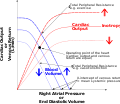 Starling curve showing the relationship between right atrial pressure and cardiac output.
 -
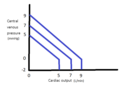 Vascular function curve illustrating the relationship between venous return and right atrial pressure.
 -
 Combined cardiac and vascular function curves.
 -
 Venous return curves demonstrating the effects of different physiological conditions.


References
- Guyton, A. C., & Hall, J. E. (2006). Textbook of Medical Physiology. Elsevier Saunders.
- Berne, R. M., & Levy, M. N. (2001). Cardiovascular Physiology. Mosby.
-
Starling's Law of the Heart and Right Atrial Pressure
-
Vascular Function Curve
-
Cardiac and Vascular Function Curves
-
Venous Return Curves
