Tihar (festival): Difference between revisions
CSV import |
CSV import |
||
| Line 25: | Line 25: | ||
{{Nepal-stub}} | {{Nepal-stub}} | ||
{{India-stub}} | {{India-stub}} | ||
<gallery> | |||
File:Kathmandu_Tihar_Swayambhu.jpg|Swayambhu Stupa decorated during Tihar festival | |||
File:Dog_worship_in_Hinduism.jpg|Dog being worshipped during Tihar festival | |||
File:The_Cow_Worship.jpg|Cow being worshipped during Tihar festival | |||
File:Sister_lighting_traditional_lamp_during_Tihar_festival_(edited).jpg|Sister lighting traditional lamp during Tihar festival | |||
</gallery> | |||
Latest revision as of 04:25, 18 February 2025
Tihar (also known as Deepawali and Swanti) is a five-day-long Hindu festival celebrated in the Indian subcontinent, notably in Nepal and the Indian states of Assam and Sikkim. The festival is observed in the month of Kartik (October/November) in the Hindu lunar calendar.
Etymology[edit]
The term Tihar derives from the Sanskrit word Deepawali, which translates to "row of lamps". This is in reference to the tradition of lighting oil lamps during the festival.
Observance[edit]
Tihar is celebrated for five days, each day dedicated to different rituals and traditions. The first day is known as Kag Tihar, dedicated to the worship of crows. The second day, Kukur Tihar, is dedicated to the worship of dogs. The third day, Gai Tihar and Laxmi Puja, is dedicated to the worship of cows in the morning and Lakshmi, the goddess of wealth, in the evening. The fourth day, Govardhan Puja and Mha Puja, is dedicated to the worship of oxen and self respectively. The fifth and final day, Bhai Tika, is dedicated to the celebration of the bond between brothers and sisters.
Significance[edit]
Tihar is a festival of lights, where oil lamps and candles are lit to welcome the goddess Lakshmi into homes. It is also a time to honor animals such as crows, dogs, cows, and oxen, who have close relationships with humans. The festival signifies the divine attachment between humans and other animals.
Traditions[edit]
During Tihar, homes and public spaces are decorated with oil lamps, candles, and colorful designs called Rangoli. People also play Deusi and Bhailo, a musical game, and exchange gifts and sweets. The festival ends with Bhai Tika, where sisters apply a Tika on their brothers' foreheads and pray for their long life and prosperity.
See also[edit]

This article is a Hinduism-related stub. You can help WikiMD by expanding it!

.svg)
-
 Swayambhu Stupa decorated during Tihar festival
 -
 Dog being worshipped during Tihar festival
 -
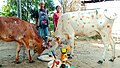 Cow being worshipped during Tihar festival
 -
 Sister lighting traditional lamp during Tihar festival


.jpg)
