Pruning: Difference between revisions
CSV import |
CSV import |
||
| Line 34: | Line 34: | ||
{{horticulture-stub}} | {{horticulture-stub}} | ||
{{forestry-stub}} | {{forestry-stub}} | ||
<gallery> | |||
File:Prunedbushcloseup.jpg|Close-up of a pruned bush | |||
File:Labelled_tree_parts.jpg|Diagram of labelled tree parts | |||
File:Arborist_pruning_Statue_of_Liberty.jpg|Arborist pruning near the Statue of Liberty | |||
File:Pruning_of_trees_in_Chandigarh.jpg|Pruning of trees in Chandigarh | |||
</gallery> | |||
Latest revision as of 04:23, 18 February 2025
Pruning is a horticultural and silvicultural practice involving the selective removal of certain parts of a plant, such as branches, buds, or roots. Reasons to prune plants include deadwood removal, shaping (by controlling or directing growth), improving or maintaining health, reducing risk from falling branches, preparing nursery specimens for transplanting, and both harvesting and increasing the yield or quality of flowers and fruits.
Purpose[edit]
The practice of pruning is important in horticulture and silviculture, where it is the selective removal of parts of a plant, such as branches, buds, or roots. This is done for a variety of reasons, including deadwood removal, shaping (by controlling or directing growth), improving or maintaining health, reducing risk from falling branches, preparing nursery specimens for transplanting, and both harvesting and increasing the yield or quality of flowers and fruits.
Techniques[edit]
There are several techniques used in the practice of pruning, such as crown thinning, crown raising, and crown reduction. Each of these techniques has a specific purpose and is used in different situations. For example, crown thinning is used to allow more light to pass through the tree, while crown raising is used to provide clearance for pedestrians.
Tools[edit]
There are several tools that are commonly used in pruning. These include hand pruners, lopping shears, and pruning saws. Each of these tools has a specific use and is chosen based on the size and type of branch that needs to be pruned.
Timing[edit]
The timing of pruning can greatly affect the health and growth of the plant. In general, the best time to prune a plant is during its dormant season. However, there are exceptions to this rule, such as when pruning to correct a hazard or to remove dead wood.
See also[edit]
References[edit]
<references />
 | This horticulture article is a stub. You can help Wikipedia by adding missing information. |
-
 Close-up of a pruned bush
 -
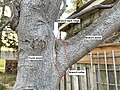 Diagram of labelled tree parts
 -
 Arborist pruning near the Statue of Liberty
 -
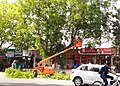 Pruning of trees in Chandigarh


