Ssam: Difference between revisions
CSV import Tags: mobile edit mobile web edit |
CSV import |
||
| Line 19: | Line 19: | ||
[[Category:Vegetable dishes]] | [[Category:Vegetable dishes]] | ||
{{Korea-food-stub}} | {{Korea-food-stub}} | ||
<gallery> | |||
File:Ssam_2.jpg|Ssam | |||
File:Ssam_vegetables_and_ssamjang.jpg|Ssam vegetables and ssamjang | |||
File:Korean_cuisine-Ssam-01.jpg|Korean cuisine Ssam | |||
File:Gwangju-Bossam.jpg|Gwangju Bossam | |||
File:Korean_cuisine-Ssam-05.jpg|Korean cuisine Ssam | |||
File:Korean_cuisine-Ssam-04.jpg|Korean cuisine Ssam | |||
</gallery> | |||
Latest revision as of 04:22, 18 February 2025
Ssam is a term in Korean cuisine that refers to a dish in which, usually, leafy vegetables are used to wrap a piece of meat such as pork or other fillings. It is often accompanied by a condiment known as ssamjang and can be garnished with items like kimchi or garlic.
Etymology[edit]
The word "ssam" in Korean literally translates to "wrapped," referring to the nature of the dish where fillings are wrapped in leafy vegetables.
Ingredients and Preparation[edit]
The main component of ssam is the leafy vegetable used for wrapping. Commonly used vegetables include lettuce, perilla leaves, and cabbage. The fillings can vary widely, but the most common is grilled pork belly, known as samgyeopsal in Korean. Other possible fillings include bulgogi (marinated beef), galbi (marinated short ribs), or any other type of grilled or cooked meat.
The meat is usually marinated with a mixture of soy sauce, sugar, garlic, and sesame oil before being grilled. Once the meat is cooked, it is placed on the leafy vegetable, often along with ssamjang, a thick, spicy paste made from doenjang (fermented soybean paste) and gochujang (red chili paste). Other common additions include slices of garlic, green chili peppers, or a piece of kimchi.
Variations[edit]
There are many variations of ssam in Korean cuisine. For example, bossam is a type of ssam where boiled pork is wrapped in napa cabbage. Oysters are often added to bossam during the winter months when they are in season. Another variation is naengmyeon ssam, where cold buckwheat noodles are wrapped in lettuce or perilla leaves.
Cultural Significance[edit]
Ssam is a popular dish in Korean cuisine and is often eaten at barbecues and family gatherings. It is also a common dish in Korean barbecue restaurants around the world. The act of wrapping the meat and other ingredients in the leafy vegetable is often done at the table, allowing each person to customize their ssam according to their personal taste.

-
 Ssam
Ssam -
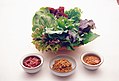 Ssam vegetables and ssamjang
 -
 Korean cuisine Ssam
 -
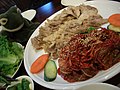 Gwangju Bossam
 -
 Korean cuisine Ssam
 -
 Korean cuisine Ssam


