Identity by descent: Difference between revisions
CSV import Tags: mobile edit mobile web edit |
CSV import |
||
| Line 31: | Line 31: | ||
{{Genetics-stub}} | {{Genetics-stub}} | ||
<gallery> | |||
File:Pedigree,_recombination_and_resulting_IBD_segments,_schematic_representation.png|Pedigree, recombination and resulting IBD segments, schematic representation | |||
File:Pedigree,_recombination_and_resulting_IBD_segments,_schematic_representation_modified.png|Pedigree, recombination and resulting IBD segments, schematic representation modified | |||
File:IBD_segment_detected_by_HapFABIA_in_1000Genomes.png|IBD segment detected by HapFABIA in 1000 Genomes | |||
</gallery> | |||
Latest revision as of 04:21, 18 February 2025
Identity by Descent (IBD) refers to the genetic phenomenon where two or more individuals inherit the same segment of DNA from a common ancestor. This concept is fundamental in the fields of genetics, genealogy, and population genetics, providing insights into genetic relationships, ancestry, and the inheritance of traits.
Overview[edit]
IBD occurs when individuals inherit identical segments of DNA from a shared ancestor without any recombination events disrupting the segment. These segments are passed down through generations, and their identification helps in understanding the genetic structure of populations, the relatedness between individuals, and the inheritance patterns of certain genetic traits or diseases.
Mechanisms[edit]
The process of inheritance involves the recombination of DNA from the parents to form the genetic material of the offspring. However, some segments of DNA are passed down through generations without recombination, remaining intact. These segments represent the IBD regions. The likelihood of IBD sharing decreases with each generation, as recombination events tend to break down these segments over time.
Applications[edit]
- Genealogical Research###
IBD is a powerful tool in genealogy, allowing researchers to identify common ancestors between individuals by analyzing the segments of DNA that have been inherited identically by descent. This can help in constructing family trees and understanding familial relationships.
- Genetic Genealogy###
In genetic genealogy, IBD segments are used to estimate the degree of relatedness between individuals. Services like DNA testing companies analyze IBD segments to provide insights into an individual's ancestry and connections to distant relatives.
- Population Genetics###
IBD analysis is crucial in population genetics for studying the genetic structure and history of populations. It helps in understanding migration patterns, population bottlenecks, and the spread of genetic traits or diseases.
- Medical Genetics###
In medical genetics, identifying IBD segments can help in understanding the inheritance patterns of genetic diseases. It can also assist in identifying potential genetic risks and in the development of personalized medicine strategies.
Challenges[edit]
One of the main challenges in IBD analysis is distinguishing between IBD and identity by state (IBS), where two individuals share identical DNA segments by chance rather than by inheritance from a common ancestor. Advanced computational methods and large genomic datasets are required to accurately identify IBD segments.
Conclusion[edit]
Identity by Descent is a fundamental concept in genetics that has wide-ranging applications from genealogical research to medical genetics. Its study helps in understanding the genetic connections between individuals, the structure of populations, and the inheritance of genetic traits and diseases.

-
 Pedigree, recombination and resulting IBD segments, schematic representation
 -
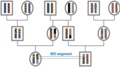 Pedigree, recombination and resulting IBD segments, schematic representation modified
 -
 IBD segment detected by HapFABIA in 1000 Genomes


