OCLC: Difference between revisions
CSV import Tags: mobile edit mobile web edit |
CSV import |
||
| Line 30: | Line 30: | ||
[[Category:Library cooperatives]] | [[Category:Library cooperatives]] | ||
{{Library-stub}} | {{Library-stub}} | ||
<gallery> | |||
File:Kilgour_Building,_OCLC,_Dublin,_OH.jpg|Kilgour Building, OCLC, Dublin, OH | |||
File:OCLC_Online_Computer_Library_Center_aerial_view_-_DPLA_-_f77302059c9901bd7622272437e9f8d6.jpg|OCLC Online Computer Library Center aerial view | |||
File:Schipholweg_99,_Leiden.JPG|OCLC | |||
</gallery> | |||
Latest revision as of 04:13, 18 February 2025
OCLC (Online Computer Library Center) is a global library cooperative that provides shared technology services, original research, and community programs for its membership and the library community at large. It was founded in 1967 as the Ohio College Library Center and later changed its name to OCLC in 1981 to reflect its expanding services beyond Ohio.
History[edit]
OCLC was established in 1967 by the presidents of several Ohio colleges and universities who sought to create a computerized network to share library resources. The network was initially funded by a grant from the U.S. Department of Education and the Ohio Board of Regents. In 1971, OCLC introduced its first product, an online union catalog and shared cataloging system known as WorldCat.
Services[edit]
OCLC provides a variety of services to libraries, including cataloging and metadata, library management systems, digital collection services, and interlibrary loan management. The organization's most well-known service is WorldCat, a global network of library content and services that allows individuals and libraries to search the collections of thousands of libraries around the world.
WorldCat[edit]
WorldCat is a union catalog that itemizes the collections of 15,000 libraries in 107 countries around the world. It is built and maintained collectively by the participating libraries. WorldCat's database holds tens of millions of bibliographic records in over 400 languages, representing over 2 billion physical and digital assets in libraries worldwide.
Membership[edit]
OCLC membership is open to all types of libraries, including academic, public, school, government, and special libraries. Members contribute to the development of OCLC's services and benefit from the shared resources and collaborative programs.
Governance[edit]
OCLC is governed by a Board of Trustees composed of librarians and leaders in information technology and higher education. The Board is responsible for setting the strategic direction of the organization and overseeing its operations.
See also[edit]
.svg)
-
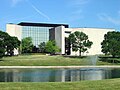 Kilgour Building, OCLC, Dublin, OH
 -
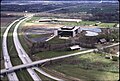 OCLC Online Computer Library Center aerial view
 -
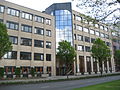 OCLC
OCLC


