Metanephric adenoma: Difference between revisions
CSV import |
CSV import |
||
| Line 31: | Line 31: | ||
{{Kidney-disease-stub}} | {{Kidney-disease-stub}} | ||
{{Medicine-stub}} | {{Medicine-stub}} | ||
<gallery> | |||
File:Metanephric_adenoma_-_very_high_mag.jpg|Metanephric adenoma - very high magnification | |||
File:metanephric_adenoma_high_mag.jpg|Metanephric adenoma high magnification | |||
File:Metanephric_adenoma_high_mag_cropped.jpg|Metanephric adenoma high magnification cropped | |||
</gallery> | |||
Revision as of 04:07, 18 February 2025
Metanephric adenoma is a rare, benign neoplasm of the kidney. It was first described in 1995 by Davis et al. and is characterized by its unique histological features and benign clinical course. Despite its benign nature, it is often misdiagnosed as a malignant renal cell carcinoma due to its similar radiological features.
Clinical Presentation
Patients with metanephric adenoma often present with non-specific symptoms such as hematuria, flank pain, and a palpable mass. However, many cases are asymptomatic and are discovered incidentally during imaging studies for unrelated conditions.
Pathology
Histologically, metanephric adenoma is characterized by small, uniform cells with scant cytoplasm and round to oval nuclei. The cells are arranged in tightly packed acini, tubules, or papillae. Despite its benign nature, it can be difficult to distinguish from malignant renal cell carcinoma on imaging studies due to its similar appearance.
Diagnosis
The diagnosis of metanephric adenoma is often made postoperatively, as preoperative diagnosis is challenging due to its similar radiological features to renal cell carcinoma. Histological examination of the tumor is necessary for definitive diagnosis.
Treatment
The treatment of choice for metanephric adenoma is surgical resection. Due to its benign nature, the prognosis is excellent with no reported cases of metastasis or recurrence after complete resection.
Epidemiology
Metanephric adenoma is a rare tumor, accounting for less than 1% of all renal neoplasms. It can occur at any age but is most commonly seen in middle-aged women.
See Also
This article is a kidney disease stub. You can help WikiMD by expanding it!

-
 Metanephric adenoma - very high magnification
 -
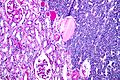 Metanephric adenoma high magnification
 -
 Metanephric adenoma high magnification cropped


