Trigona: Difference between revisions
CSV import |
CSV import |
||
| Line 54: | Line 54: | ||
[[Category:Stingless bees]] | [[Category:Stingless bees]] | ||
[[Category:Pollinators]] | [[Category:Pollinators]] | ||
<gallery> | |||
File:Irapuã_-_REFON.jpg|Trigona | |||
File:Arboreal_stingless_bee_nest_(Trigona_sp.)_Flores.jpg|Arboreal stingless bee nest (Trigona sp.) | |||
File:Trigona_caixa_nordestina.jpg|Trigona caixa nordestina | |||
</gallery> | |||
Latest revision as of 03:51, 18 February 2025
Genus of stingless bees
Trigona is a genus of stingless bees in the tribe Meliponini, within the family Apidae. These bees are known for their eusocial behavior and are found primarily in tropical and subtropical regions.
Description[edit]
Trigona bees are small to medium-sized, with a body length ranging from 3 to 10 mm. They are characterized by their lack of a sting, which is a common trait among the Meliponini. Despite their lack of a sting, they can defend their nests using their powerful mandibles and by swarming intruders.
Habitat[edit]
Trigona species are typically found in tropical and subtropical regions, including parts of Central America, South America, Africa, and Southeast Asia. They inhabit a variety of environments, from dense forests to open savannas.
Nesting[edit]
Trigona bees build their nests in a variety of locations, including tree cavities, underground, and in man-made structures. The nests are made from a mixture of wax and plant resins, which the bees collect and process. The nests can vary greatly in size and complexity.
_Flores.jpg)
Behavior[edit]
Trigona bees are highly social insects, living in colonies that can contain thousands of individuals. They have a complex social structure with a single queen, workers, and drones. The workers are responsible for foraging, nest maintenance, and caring for the brood.
Foraging[edit]
These bees are important pollinators and forage for nectar and pollen from a wide variety of plants. They are known to visit flowers that are often ignored by other pollinators, making them crucial for the pollination of certain plant species.
Economic Importance[edit]
Trigona bees are valued for their role in pollination and for the production of honey, which is often used in traditional medicine. The honey produced by stingless bees is different from that of the more common honey bees, being less sweet and more liquid.

Conservation[edit]
The conservation of Trigona bees is important due to their ecological role as pollinators. Habitat destruction and the use of pesticides pose significant threats to their populations. Efforts to conserve their habitats and promote sustainable beekeeping practices are essential for their survival.
Related pages[edit]
References[edit]
- Roubik, D. W. (2006). "Stingless bee nesting biology." Apidologie, 37(2), 124-143.
- Michener, C. D. (2007). "The Bees of the World." Johns Hopkins University Press.
-
 Trigona
 -
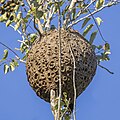 Arboreal stingless bee nest (Trigona sp.)
 -
 Trigona caixa nordestina

