Plasmodiophora brassicae: Difference between revisions
CSV import Tags: mobile edit mobile web edit |
CSV import |
||
| Line 22: | Line 22: | ||
[[Category:Phytomyxea]] | [[Category:Phytomyxea]] | ||
{{plant-disease-stub}} | {{plant-disease-stub}} | ||
<gallery> | |||
File:Plasmodiophora_brassicae_on_cauliflower,_Knolvoet_bij_bloemkool_(6).jpg|Plasmodiophora brassicae on cauliflower | |||
File:Abb6.28_Plasmodiophorales_Plasmodiophora_brassicae_life_cycle_Brassica_oleracea_clubroot_2021_(M._Piepenbring).png|Plasmodiophora brassicae life cycle | |||
</gallery> | |||
Latest revision as of 02:15, 18 February 2025
Plasmodiophora brassicae is a soil-borne pathogen that causes clubroot, a disease that affects cruciferous crops. It is a member of the Phytomyxea class and is known for its unique life cycle and the significant economic impact it has on agriculture worldwide.
Taxonomy[edit]
Plasmodiophora brassicae belongs to the Phytomyxea class, which is part of the Rhizaria supergroup. It is the only species in the Plasmodiophora genus that is pathogenic to plants.
Life Cycle[edit]
The life cycle of Plasmodiophora brassicae is complex and involves several stages. It begins with the release of zoospores from resting spores in the soil. These zoospores infect the roots of host plants, where they multiply and form plasmodia. The plasmodia eventually produce new zoospores, which are released into the soil when the host plant's root cells rupture. These zoospores can infect new host plants or form resting spores, which can survive in the soil for many years.
Disease Symptoms and Impact[edit]
Clubroot is the disease caused by Plasmodiophora brassicae. Symptoms include swelling and distortion of the roots, which can lead to wilting and stunting of the plant. This disease can cause significant yield losses in affected crops, making it a major concern for farmers and agricultural industries worldwide.
Management[edit]
Management of Plasmodiophora brassicae involves a combination of cultural practices, chemical treatments, and the use of resistant varieties. Cultural practices include crop rotation and sanitation measures to reduce the amount of resting spores in the soil. Chemical treatments can be used to kill the pathogen, but they are often not economically feasible for large-scale use. The use of resistant varieties is the most effective long-term strategy for managing this pathogen.
See Also[edit]

This article is a plant disease stub. You can help WikiMD by expanding it!
-
 Plasmodiophora brassicae on cauliflower
 -
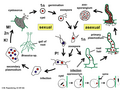 Plasmodiophora brassicae life cycle
.jpg)
.png)
