Lilium canadense: Difference between revisions
CSV import |
CSV import |
||
| Line 21: | Line 21: | ||
[[Category:Lilium]] | [[Category:Lilium]] | ||
{{plant-stub}} | {{plant-stub}} | ||
<gallery> | |||
File:CanadaLily.jpg|Lilium canadense in bloom | |||
File:Lillium_canadense_-_Canada_Lily.jpg|Close-up of Lilium canadense | |||
File:Lilium_canadense_001.jpg|Lilium canadense in its natural habitat | |||
</gallery> | |||
Latest revision as of 02:13, 18 February 2025
Lilium canadense, also known as the Canada Lily, Wild Yellow-Lily, or Meadow Lily, is a species of lily native to North America. It is a perennial, herbaceous plant that typically grows in moist, woodland environments.
Description[edit]
The Lilium canadense plant grows from a bulb and can reach heights of 1 to 2 meters. Its leaves are lanceolate (lance-shaped) and arranged in whorls along the stem. The flowers are large, showy, and typically yellow or orange in color, although red varieties also exist. Each flower has six tepals (three petals and three sepals of similar appearance) that are strongly recurved (bent backwards), giving the flower a distinctive, "turk's cap" shape.
Distribution and Habitat[edit]
Lilium canadense is native to eastern North America, from Nova Scotia in the north to Georgia in the south, and west to Minnesota. It is typically found in moist, deciduous or mixed forests, and in meadows and along streambanks.
Cultivation[edit]
Lilium canadense is cultivated as an ornamental plant in gardens for its showy flowers. It prefers a moist, well-drained soil and a position in full sun or partial shade. It is hardy to USDA zone 3.
Conservation[edit]
In some parts of its range, Lilium canadense is considered threatened or endangered due to habitat loss and over-collection. Conservation efforts are underway to protect and restore populations of this species.
References[edit]
- Flora of North America
- The Plant List
- IUCN Red List of Threatened Species

-
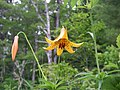 Lilium canadense in bloom
 -
 Close-up of Lilium canadense
 -
 Lilium canadense in its natural habitat


