Indeterminate growth: Difference between revisions
CSV import |
CSV import |
||
| Line 28: | Line 28: | ||
[[Category:Developmental biology]] | [[Category:Developmental biology]] | ||
{{biology-stub}} | {{biology-stub}} | ||
<gallery> | |||
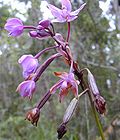
File:Spathoglottis_flwrs_reduced.jpg|Indeterminate_growth | |||
File:Cymose_determinate_inflorescences.jpg|Indeterminate_growth | |||
</gallery> | |||
Latest revision as of 02:13, 18 February 2025
Indeterminate growth refers to the continuous growth of an organism throughout its life. This is in contrast to determinate growth, where an organism stops growing after reaching a certain size or age. Indeterminate growth is common in many species, including fish, reptiles, and plants.
Overview[edit]
Indeterminate growth is a type of growth pattern where an organism continues to grow in size throughout its life. This is due to the continuous division and differentiation of cells in certain tissues, such as the meristem in plants and the epidermis in animals. The rate of growth may slow down as the organism ages, but it does not stop completely.
In Animals[edit]
In the animal kingdom, indeterminate growth is common in many species of fish and reptiles. For example, koi fish and pythons are known to grow continuously throughout their lives. This growth is often influenced by environmental factors such as food availability and temperature.
In Plants[edit]
In plants, indeterminate growth is facilitated by the meristem, a type of tissue found at the tips of roots and shoots. The meristem contains undifferentiated cells that can divide and differentiate into various types of plant cells, allowing the plant to grow continuously. This is why trees, for example, can grow taller and wider year after year.
Factors Influencing Indeterminate Growth[edit]
Several factors can influence indeterminate growth, including genetics, environmental conditions, and the availability of resources. For instance, a lack of nutrients can stunt growth, while optimal conditions can promote it. In some cases, organisms with indeterminate growth can reach impressive sizes, such as the giant sequoia tree or the greenland shark.
See Also[edit]

-
 Indeterminate_growth
 -
 Indeterminate_growth


