Kolbe–Schmitt reaction: Difference between revisions
CSV import Tags: mobile edit mobile web edit |
CSV import |
||
| Line 29: | Line 29: | ||
{{Chemistry-stub}} | {{Chemistry-stub}} | ||
<gallery> | |||
Kolbe–Schmitt_reaction | |||
File:Kolbe-Schmitt-reaction-mechanism.png|Mechanism of the Kolbe–Schmitt reaction | |||
File:K_S_startAnimGif.gif|Animation of the Kolbe–Schmitt reaction | |||
</gallery> | |||
Revision as of 02:11, 18 February 2025
Kolbe–Schmitt reaction or Kolbe process is a carboxylation chemical reaction that synthesizes salicylic acid and its derivatives. This reaction is named after the German chemists Hermann Kolbe and Rudolf Schmitt who developed the process in 1885. The Kolbe–Schmitt reaction proceeds by the nucleophilic addition of carbon dioxide to a phenoxide, which is formed from the deprotonation of a phenol. The reaction is significant in both organic chemistry and the pharmaceutical industry, particularly in the production of aspirin and other salicylate drugs.
Reaction Mechanism
The Kolbe–Schmitt reaction begins with the treatment of a phenol with a strong base, typically potassium hydroxide (KOH), resulting in the formation of a potassium phenoxide. This phenoxide then reacts with carbon dioxide under high pressure and temperature to form a potassium salicylate. Acidification of the potassium salicylate yields salicylic acid, a key precursor in the synthesis of aspirin and other pharmaceuticals.
The general reaction can be represented as follows:
Phenol + CO2 (high pressure, high temperature) → Salicylic acid
Applications
The primary application of the Kolbe–Schmitt reaction is in the pharmaceutical industry for the production of salicylic acid and its derivatives. Salicylic acid is a precursor to aspirin (acetylsalicylic acid), one of the most widely used medications for pain relief, fever reduction, and anti-inflammatory purposes. Additionally, salicylic acid derivatives produced through this reaction are used in the manufacture of dyes, fragrances, and preservatives.
Advantages and Limitations
One of the main advantages of the Kolbe–Schmitt reaction is its straightforward mechanism, which allows for the efficient production of salicylic acid and its derivatives. However, the reaction conditions—high pressure and temperature—can be considered a limitation as they require specialized equipment and can increase production costs. Furthermore, the reaction's specificity to phenols limits its applicability to a narrower range of substrates.
Environmental Considerations
The environmental impact of the Kolbe–Schmitt reaction is a topic of ongoing research. While the reaction itself does not produce significant toxic byproducts, the use of high pressure and temperature conditions raises concerns regarding energy consumption and the carbon footprint of the process. Efforts to develop more sustainable versions of the Kolbe–Schmitt reaction are focused on lowering the reaction conditions and finding greener alternatives for the reagents used.
See Also

-
 Mechanism of the Kolbe–Schmitt reaction
 -
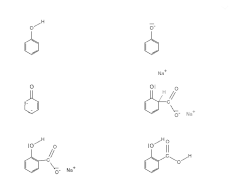 Animation of the Kolbe–Schmitt reaction


