Phosphatidylinositol: Difference between revisions
CSV import Tags: mobile edit mobile web edit |
CSV import |
||
| Line 32: | Line 32: | ||
[[Category:Signal transduction]] | [[Category:Signal transduction]] | ||
{{medicine-stub}} | {{medicine-stub}} | ||
<gallery> | |||
File:Phosphatidylinositol_structure_with_components.jpg|Structure of Phosphatidylinositol with components | |||
File:Phosphatidylinositol_hydrolysis_and_synthesis.jpg|Phosphatidylinositol hydrolysis and synthesis | |||
</gallery> | |||
Latest revision as of 02:09, 18 February 2025
Phosphatidylinositol (abbreviated PI) is a class of lipids, specifically a phospholipid, which is an integral component of cell membranes in eukaryotic cells. It is composed of a glycerol backbone with two fatty acid chains, a phosphate group, and an inositol ring.
Structure and Synthesis[edit]
Phosphatidylinositol is synthesized in the endoplasmic reticulum from cytidine diphosphate-diacylglycerol (CDP-DAG) and inositol. The inositol ring can be phosphorylated by various kinases on the 3, 4, and 5 positions of the ring.
Function[edit]
Phosphatidylinositol plays a key role in several biological functions. It is a precursor for many second messengers that are important in transmitting signals from the cell surface to the cell interior. These include inositol trisphosphate (IP3) and diacylglycerol (DAG), which are produced by the action of phospholipase C (PLC) on phosphatidylinositol 4,5-bisphosphate (PIP2).
Phosphatidylinositol also plays a crucial role in protein trafficking by acting as a docking site for certain types of proteins. The phosphorylated forms of phosphatidylinositol, known as phosphoinositides, are located on the inner leaflet of the cell membrane and can bind to specific domains in proteins, targeting them to the membrane.
Clinical Significance[edit]
Alterations in phosphatidylinositol metabolism have been implicated in several diseases, including cancer, diabetes, and bipolar disorder. For example, mutations in the gene encoding phosphatidylinositol 4,5-bisphosphate 3-kinase (PIK3CA), which phosphorylates PIP2 to produce PIP3, have been found in many types of cancer.
See Also[edit]
References[edit]
<references group="" responsive="1"></references>

-
 Structure of Phosphatidylinositol with components
 -
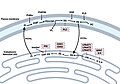 Phosphatidylinositol hydrolysis and synthesis


